
The cybersecurity industry is changing fast. Every year, organizations deploy new technologies, cloud services, APIs, and complex enterprise environments. At the same time, attackers continue evolving their techniques. Because of this, reading theory alone is no longer enough for aspiring security professionals.
Hands-on practice has become one of the most important parts of learning cybersecurity.
That is exactly where PentestHint Labs comes into the picture.
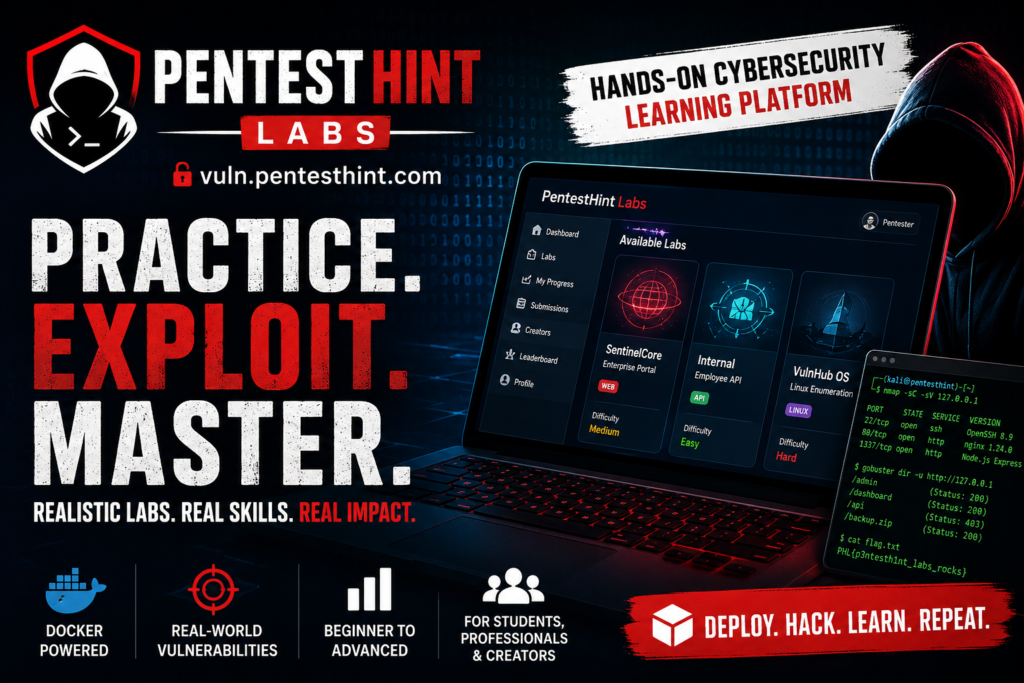
Built for students, security enthusiasts, bug bounty hunters, penetration testers, and creators, PentestHint Labs is a practical learning platform designed to simulate real-world vulnerable environments using Docker-based machines and web applications.
Instead of solving unrealistic puzzles, users get access to labs that mimic enterprise-style environments, authentication systems, APIs, dashboards, internal portals, Linux services, Active Directory concepts, and modern web technologies.
The goal is simple:
Learn offensive security by practicing on realistic environments in a safe and structured way.
What is PentestHint Labs?
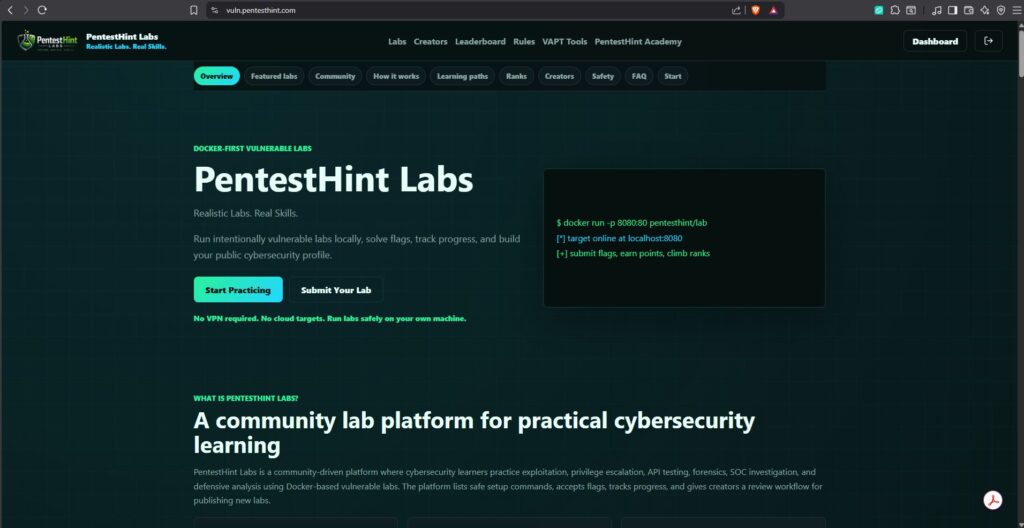
PentestHint Labs is a platform where users can deploy intentionally vulnerable applications and machines locally using Docker containers.
Each lab is carefully designed to help learners understand:
- Vulnerability discovery
- Exploitation techniques
- Misconfigurations
- Web security flaws
- API security issues
- Authentication weaknesses
- Linux and infrastructure exposure
- Real-world attack paths
Unlike many traditional CTF-style platforms, the focus here is not just “finding flags.”
The focus is understanding:
- how vulnerabilities happen,
- why developers miss them,
- how attackers exploit them,
- and how defenders can fix them.
Why Hands-On Labs Matter in Cybersecurity
Cybersecurity is not a field where theory alone creates expertise.
You can read about SQL Injection, SSRF, IDOR, or Command Injection all day, but unless you actually:
- intercept requests,
- modify parameters,
- analyze responses,
- understand backend behavior,
- and exploit flaws yourself,
the concepts remain incomplete.
Practical labs help bridge the gap between:
- learning,
- understanding,
- and actual execution.
That is why many companies today prefer candidates who can demonstrate:
- real attack understanding,
- lab experience,
- tool familiarity,
- and problem-solving ability.
Hands-on environments improve:
- analytical thinking,
- debugging skills,
- enumeration methodology,
- exploitation workflow,
- and reporting capability.
Designed for Students, Professionals, and Creators
One of the biggest advantages of PentestHint Labs is that it supports multiple types of users.
For Students
Students can:
- practice vulnerabilities safely,
- improve technical skills,
- prepare for interviews,
- learn penetration testing,
- and build confidence before entering the industry.
The platform helps beginners understand how real applications behave instead of learning only from slides or PDFs.
For Security Professionals
Professionals can use the platform to:
- sharpen exploitation skills,
- practice attack chains,
- simulate assessments,
- train teams,
- and validate methodologies.
The labs are also useful for internal training programs and cybersecurity workshops.
For Content Creators & Trainers
Cybersecurity creators often struggle with building stable vulnerable environments for demonstrations.
PentestHint Labs simplifies this process by providing Docker-based setups that can be deployed quickly.
Creators can:
- record walkthroughs,
- teach exploitation,
- conduct workshops,
- create lab exercises,
- and demonstrate vulnerabilities consistently.
Because environments are containerized, setups become repeatable and easier to manage.
What Makes PentestHint Labs Different?
There are many learning platforms available online today, but PentestHint Labs focuses heavily on realism and usability.
1. Docker-Based Deployment
Every lab is designed using Docker technology.
This means users can:
- deploy labs quickly,
- isolate environments,
- avoid dependency issues,
- reset machines easily,
- and practice locally on their own systems.
Docker makes lab deployment significantly smoother compared to manually configuring vulnerable VMs.

2. Realistic Enterprise UI
Most vulnerable practice applications look obviously fake.
PentestHint Labs takes a different approach.
Applications are designed to resemble:
- enterprise portals,
- admin dashboards,
- internal systems,
- APIs,
- employee management portals,
- authentication gateways,
- and business applications.
This helps learners experience environments closer to real penetration testing engagements.
3. Structured Learning
Each lab contains:
- descriptions,
- objectives,
- difficulty levels,
- deployment instructions,
- and challenge-based questions.
This structure helps learners progress systematically instead of randomly attacking applications.
4. Beginner to Advanced Progression
The platform supports multiple difficulty levels:
- Beginner
- Intermediate
- Advanced
Users can gradually improve from basic web vulnerabilities to more complex attack scenarios.

Understanding Docker in PentestHint Labs
Many beginners hear the word “Docker” but do not fully understand why it matters in cybersecurity labs.
Docker is a containerization technology that packages applications along with their dependencies.
Instead of installing vulnerable software directly on your operating system, Docker creates isolated containers.
Benefits include:
- cleaner setup,
- reduced compatibility issues,
- fast deployment,
- easier resets,
- and safer practice environments.
For example, a vulnerable web application can run inside a container on:
- port 8080,
- port 1337,
- or any mapped port,
without affecting the host system.
Typical deployment commands look like:
docker pull pentesthint/phvl-001:latest
docker run -d -p 8080:80 pentesthint/phvl-001:latest
This makes cybersecurity practice accessible even for beginners.
How to Use PentestHint Labs
The process is designed to be simple.
Step 1: Choose a Lab
Visit:
vuln.pentesthint.com
Browse available labs by:
- category,
- difficulty,
- or topic.
Step 2: Read the Objective
Every lab includes:
- challenge overview,
- deployment instructions,
- expected skills,
- and learning outcomes.
Step 3: Deploy Using Docker
Pull the Docker image and start the lab locally.
Example:
docker pull pentesthint/phvl-001-sentinelcore-enterprise-portal:latest
docker run -d -p 1337:1337 pentesthint/phvl-001-sentinelcore-enterprise-portal:latest
Once deployed, the application becomes accessible in your browser.
Step 4: Analyze & Exploit
Learners can:
- intercept traffic,
- enumerate functionality,
- analyze parameters,
- identify vulnerabilities,
- exploit flaws,
- and capture flags.
Step 5: Submit Answers
After identifying the correct flag or solving the challenge, users submit their answers through the platform.
This helps:
- validate learning,
- track progress,
- and encourage structured practice.
For Creators: Submit Your Own Labs
One of the most exciting parts of PentestHint Labs is the creator ecosystem.
Security researchers and trainers can submit their own vulnerable machines or applications.
This opens opportunities for:
- community contributions,
- technical exposure,
- portfolio building,
- and collaborative learning.
Creators can design:
- web vulnerabilities,
- API flaws,
- Linux challenges,
- authentication weaknesses,
- SSRF scenarios,
- IDOR labs,
- command injection machines,
- or enterprise attack chains.
How Creators Can Submit Labs
The creator workflow generally includes:
1. Build the Lab
Create the vulnerable application or machine.
2. Containerize with Docker
Prepare:
- Dockerfile,
- dependencies,
- source code,
- configuration files,
- and deployment instructions.
3. Add Documentation
Creators should provide:
- lab description,
- difficulty,
- category,
- objectives,
- and validation details.
4. Include Flags
Flags are used to verify successful exploitation.
Example format:
PHL{example_flag_here}5. Submit to the Platform
After review and validation, labs can become available publicly on the platform.
Skills You Can Improve
PentestHint Labs helps learners practice multiple cybersecurity domains including:
- Web Application Security
- API Security
- Linux Enumeration
- Authentication Attacks
- SQL Injection
- Command Injection
- IDOR
- XSS
- SSRF
- File Upload Vulnerabilities
- JWT Misconfigurations
- Access Control Issues
- Container Security
- Infrastructure Enumeration
Over time, these skills become highly valuable for:
- VAPT roles,
- bug bounty hunting,
- SOC operations,
- red teaming,
- and cybersecurity consulting.
Building Practical Confidence
One major challenge many students face is confidence.
Reading tutorials feels very different from attacking a live application.
Hands-on labs help users:
- think critically,
- debug problems,
- handle unexpected behavior,
- and build real troubleshooting capability.
This practical exposure often becomes the difference between:
- theoretical understanding,
- and operational skill.
The Future of Cybersecurity Learning
The industry is moving toward:
- practical validation,
- real-world simulations,
- hands-on assessments,
- and lab-based evaluation.
Platforms like PentestHint Labs are helping bridge the gap between traditional learning and practical execution.
Whether someone is:
- starting a cybersecurity journey,
- preparing for a penetration testing role,
- building a portfolio,
- teaching others,
- or improving offensive security skills,
practical labs provide one of the best ways to learn.
Final Thoughts
Cybersecurity is best learned by doing.
Practical labs create an environment where learners can:
- safely experiment,
- understand vulnerabilities deeply,
- and gain real-world offensive security experience.
With Docker-based deployment, realistic applications, creator-driven labs, and structured learning workflows, PentestHint Labs aims to provide a modern platform for practical cybersecurity education.
If you want to improve your penetration testing skills through realistic hands-on environments, explore:
The best way to understand cybersecurity is to start testing, analyzing, and learning directly from live environments.