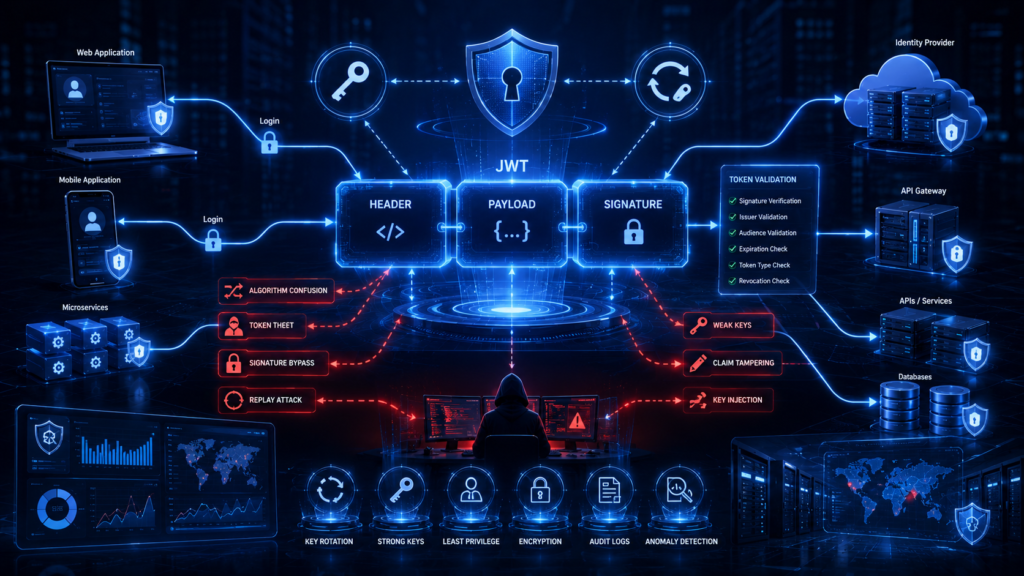
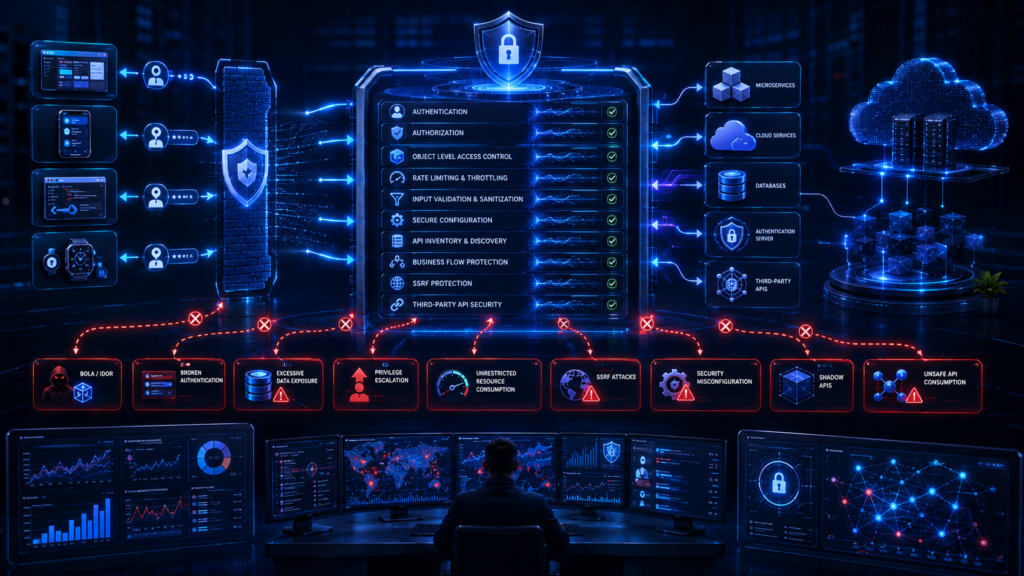
APIs are now at the center of modern applications. Mobile apps, SaaS platforms, cloud services, payment systems, microservices, and third-party integrations all depend on APIs to exchange data and perform business operations.
That makes API security a major application-security concern. The OWASP API Security Top 10 provides a practical framework for understanding the security risks that commonly affect APIs and the controls developers and security teams should consider.
The current OWASP API Security Top 10 list is the 2023 edition, which includes ten risks ranging from broken object-level authorization and authentication failures to SSRF, security misconfiguration, and unsafe consumption of third-party APIs.
One important point stands out from the 2023 update: authorization remains a major challenge. Three of the first five risks are directly related to authorization or access control. OWASP also introduced Unrestricted Access to Sensitive Business Flows and added SSRF as a dedicated API risk.
This deep dive explains each category in practical terms, shows how vulnerabilities can appear in real applications, and outlines how developers and penetration testers can approach API security testing.
What Is the OWASP API Security Top 10?
The OWASP API Security Top 10 is a security awareness and risk framework specifically designed for APIs.
It differs from the general OWASP Web Application Security Top 10 because APIs have their own attack surface and business-logic problems.
The 2023 list contains:
- API1:2023 – Broken Object Level Authorization
- API2:2023 – Broken Authentication
- API3:2023 – Broken Object Property Level Authorization
- API4:2023 – Unrestricted Resource Consumption
- API5:2023 – Broken Function Level Authorization
- API6:2023 – Unrestricted Access to Sensitive Business Flows
- API7:2023 – Server Side Request Forgery
- API8:2023 – Security Misconfiguration
- API9:2023 – Improper Inventory Management
- API10:2023 – Unsafe Consumption of APIs
The official OWASP project is a useful reference when performing an API security assessment or building an API security testing methodology.
Why Is API Security Important?
Traditional web applications often expose functionality through a user interface.
APIs expose the underlying functionality more directly.
For example, a web application may display:
GET /account/profileBehind the interface, the API could provide:
{
  "id": 1042,
  "name": "John",
  "email": "john@example.com",
  "role": "user"
}
An attacker does not necessarily need to interact with the graphical interface. They can inspect requests, manipulate parameters, change object identifiers, alter HTTP methods, or send requests directly to API endpoints.
This makes authorization, input validation, authentication, inventory management, and business-logic protection especially important.
For security teams, the API should be treated as a direct attack surface rather than simply another backend component.
API1:2023 – Broken Object Level Authorization
Broken Object Level Authorization, commonly associated with BOLA and historically with IDOR-style vulnerabilities, occurs when an API fails to verify whether the authenticated user is allowed to access a specific object.
Consider:
GET /api/orders/1001
Authorization: Bearer eyJ...
The authenticated user owns order 1001.
The attacker changes the identifier:
GET /api/orders/1002
Authorization: Bearer eyJ...
If the server returns another customer’s order, the API has an authorization problem.
The important issue is not whether the user is authenticated.
The user is authenticated.
The problem is whether that user has permission to access that particular object.
How to Prevent BOLA
Applications should perform authorization checks on the server for every object access.
Do not rely on:
- Hidden fields
- Client-side JavaScript
- Unpredictable IDs alone
- UI restrictions
- Simply requiring authentication
A secure API should effectively enforce:
Is the current user allowed to access object 1002?before returning or modifying it.
API2:2023 – Broken Authentication
Authentication determines who is making a request.
If authentication controls are weak, attackers may gain access to accounts or API functionality they should not control.
Common problems include:
- Weak password policies
- Missing brute-force protection
- Poor session management
- Weak token validation
- Predictable authentication tokens
- Authentication bypass
- Poorly implemented multi-factor authentication
- Username enumeration
For example:
POST /api/loginmay accept unlimited login attempts.
An attacker can automate password guessing against the endpoint.
Authentication should therefore be combined with appropriate rate limiting, secure session management, strong credential policies, and monitoring.
When APIs use JWTs or OAuth-based authentication, token validation also becomes critical.
API3:2023 – Broken Object Property Level Authorization
This category focuses on authorization at the property or field level of an object.
Consider:
{
  "name": "John",
  "email": "john@example.com",
  "role": "user",
  "accountBalance": 50000
}
A normal user may need access to name and email, but not necessarily internal administrative fields.
A related issue occurs when an API accepts fields that the user should not be allowed to modify.
For example:
PATCH /api/profilewith:
{
  "name": "John",
  "role": "admin"
}
If the backend accepts the role modification, an attacker could escalate privileges.
OWASP’s API testing guidance specifically maps excessive data exposure to API3:2023 because API responses can expose sensitive fields that the frontend does not display.
Prevention
Use explicit allowlists for:
- Response fields
- Writable properties
- Administrative attributes
- Sensitive account information
Never assume that hiding a field in the frontend makes it secure.
API4:2023 – Unrestricted Resource Consumption
An API may be vulnerable when it allows users to consume excessive resources.
Examples include:
/api/search
/api/export
/api/report
/api/upload
/api/generate
An attacker might repeatedly call an expensive endpoint or request unusually large amounts of data.
For example:
GET /api/export?records=1000000could force the backend to perform expensive database operations.
Potential Impact
Resource exhaustion can affect:
- CPU
- Memory
- Database capacity
- Network bandwidth
- Storage
- Third-party service costs
Protection
Use multiple controls:
- Rate limiting
- Request-size limits
- Pagination limits
- Query complexity restrictions
- File-size restrictions
- Concurrency limits
- Timeouts
- Resource quotas
A practical API security assessment should test whether these limits actually exist and whether they can be bypassed.
The OWASP API Security Testing Framework includes burst-request testing for API4:2023 to identify missing rate limiting.
API5:2023 – Broken Function Level Authorization
Object-level authorization asks:
Can this user access this object?
Function-level authorization asks:
Can this user perform this operation?
Imagine a normal user accessing:
GET /api/user/reportsThe application may also expose:
GET /api/admin/reportsIf a normal user can access the administrator endpoint simply by changing the URL, the application has broken function-level authorization.
Attackers may look for:
/admin/management/internal/staff/moderator- Administrative API versions
- HTTP method changes
Prevention
Authorization should be enforced server-side for every sensitive operation.
A user’s role should determine which functions they can execute, not merely which buttons appear in the frontend.
API6:2023 – Unrestricted Access to Sensitive Business Flows
This is one of the important additions in the 2023 API Security Top 10.
Some API operations are not technically vulnerable because of a coding flaw, but attackers can abuse them at scale.
Examples include:
- Ticket purchasing
- Account registration
- OTP requests
- Password recovery
- Product reservations
- Promotional claims
- Automated voting
- Coupon redemption
Imagine an online store exposing:
POST /api/checkoutAn attacker may automate requests to purchase limited-stock products faster than legitimate users.
Another example is:
POST /api/registerwhich could be abused to create thousands of fake accounts.
OWASP added this category to address abuse of sensitive business processes, including activities such as scalping and fake-account creation.
Protection
Technical controls can include:
- Rate limiting
- Bot detection
- CAPTCHA where appropriate
- Device reputation
- Behavioral analysis
- Transaction limits
- Strong identity verification
- Business-rule enforcement
The important lesson is that API security must protect business logic, not only technical endpoints.
API7:2023 – Server Side Request Forgery
Server-Side Request Forgery, or SSRF, occurs when an application makes a server-side request to a destination controlled or influenced by an attacker.
Consider:
POST /api/webhookwith:
{
  "url": "https://example.com/callback"
}
If the backend retrieves arbitrary URLs without proper validation, an attacker may attempt to make it access internal services.
Potential targets can include:
localhost
127.0.0.1
Internal services
Cloud metadata endpoints
Private network hosts
Management interfaces
APIs are particularly exposed to SSRF because webhook functionality, URL imports, remote file processing, and cloud integrations are common.
OWASP specifically highlighted SSRF in the 2023 API Top 10 because modern API architectures increasingly expose functionality that can make server-side requests.
SSRF Prevention
Use:
- Strict URL validation
- Destination allowlists
- Network segmentation
- Egress filtering
- DNS validation
- Redirect controls
- Cloud metadata protections
Do not rely only on blocking strings such as localhost.
API8:2023 – Security Misconfiguration
API security can fail because of incorrect configuration rather than vulnerable application code.
Common examples include:
- Debug mode enabled
- Verbose error messages
- Missing security headers
- Default credentials
- Exposed administrative interfaces
- Unnecessary HTTP methods
- Open API documentation
- Incorrect CORS configuration
- Outdated server software
- Excessive permissions
An error such as:
{
  "error": "Database connection failed",
  "host": "internal-db-03",
  "username": "api_user"
}
may disclose information useful to an attacker.
Prevention
Use secure configuration baselines and regularly review:
- Production settings
- API gateway rules
- CORS policies
- TLS configuration
- Authentication settings
- Error handling
- Cloud permissions
Security configuration should also be reviewed whenever infrastructure changes.
API9:2023 – Improper Inventory Management
Organizations often know about their production APIs but forget about older versions, development environments, or undocumented endpoints.
For example:
/api/v1/users
/api/v2/users
/api/v3/users
Perhaps only v3 is officially supported.
If v1 remains online with weaker authentication, it becomes an attractive target.
Other examples include:
- Shadow APIs
- Deprecated versions
- Test endpoints
- Development APIs
- Forgotten subdomains
- Exposed Swagger/OpenAPI documentation
API Discovery Matters
During a penetration test, do not limit testing to endpoints documented by the client.
Review:
- OpenAPI specifications
- Swagger documentation
- JavaScript files
- Mobile applications
- DNS records
- API gateway configurations
- Historical documentation
- Versioned endpoints
The OWASP API Security Testing Framework includes inventory-focused testing for deprecated versions, shadow endpoints, and exposed documentation.
API10:2023 – Unsafe Consumption of APIs
Modern applications rarely operate alone.
An application may consume:
Payment APIs
Cloud APIs
Email APIs
Identity APIs
Shipping APIs
Analytics APIs
AI APIs
Third-party SaaS APIs
The danger is assuming that an external API is automatically trustworthy.
Suppose your application receives data from a third-party API and directly inserts it into another component without validation.
If the external response is compromised or unexpectedly structured, it could create downstream security problems.
Secure Third-Party API Consumption
Treat external API responses as untrusted input.
Use:
- Schema validation
- Input validation
- Output encoding
- TLS
- Authentication
- Timeout controls
- Dependency monitoring
- Error handling
- Response-size limits
The application should also minimize the permissions granted to third-party integrations.
How to Test the OWASP API Security Top 10
API security testing should combine automated scanning with manual testing.
A penetration tester can begin by mapping the API attack surface.
Step 1: Discover Endpoints
Identify:
/api/v1/
/api/v2/
/users
/accounts
/admin
/orders
/payments
/webhooks
Look for both documented and undocumented endpoints.
Step 2: Understand Authentication
Determine whether the API uses:
- JWT
- OAuth 2.0
- API keys
- Session cookies
- Basic authentication
- Mutual TLS
Then test whether authentication controls are consistently enforced.
Step 3: Test Authorization
Use multiple test accounts where authorized.
For example:
User A → Object A
User B → Object B
Then determine whether User A can access or modify Object B.
This is one of the most important API penetration-testing techniques because many API vulnerabilities involve authorization rather than authentication.
Step 4: Test Input and Business Logic
Review:
- Object IDs
- JSON parameters
- HTTP methods
- Query parameters
- File uploads
- URLs
- Pagination
- Resource limits
- Sensitive business flows
Step 5: Test API Configuration
Check:
- CORS
- TLS
- Error messages
- Debug endpoints
- HTTP methods
- Documentation
- Authentication configuration
- Security headers
Step 6: Review Logging and Monitoring
Determine whether suspicious API behavior is detectable.
A secure API should provide useful security telemetry without exposing sensitive information to the client.
For practical testing, “https://vuln.pentesthint.com/” hands-on labs can help security learners practice API vulnerabilities in controlled environments.
Tools Used for API Security Testing
Several tools can support an API security assessment.
Burp Suite
Burp Suite is useful for intercepting and modifying API requests, testing authorization, manipulating parameters, and replaying requests.
OWASP ZAP
OWASP ZAP can help identify common web and API security issues and is useful for automated and manual assessments.
Postman
Postman is useful for building API requests, organizing collections, and testing different authentication and request scenarios.
Nuclei
Nuclei can support template-based security testing and endpoint assessment.
OWASP API Security Testing Framework
OWASP also provides the API Security Testing Framework, which is specifically designed around the OWASP API Security Top 10 2023. The framework currently documents coverage for all ten categories along with additional API security testing areas.
For learners developing practical application-security skills, “https://academy.pentesthint.com/” cyber security training can complement theoretical API security knowledge with structured learning.
OWASP API Security Top 10 Testing Checklist
Use this checklist during an authorized API security assessment:
- Test object-level authorization.
- Test authentication controls.
- Test sensitive response fields.
- Test mass-assignment scenarios.
- Test rate limiting.
- Test request and response size limits.
- Test function-level authorization.
- Test administrative endpoints.
- Identify sensitive business flows.
- Test bot and automation controls.
- Test URL-based functionality for SSRF.
- Review CORS and security configuration.
- Search for deprecated API versions.
- Identify shadow and undocumented endpoints.
- Review third-party API integrations.
- Validate external API responses.
- Review API logging and monitoring.
- Check API documentation exposure.
- Test authorization using multiple identities.
- Verify fixes with regression testing.
API Security Best Practices
A strong API security program should not depend on one control.
Start with authentication, but do not stop there.
Every sensitive operation needs appropriate authorization.
Validate object ownership, restrict accessible properties, protect administrative functions, and enforce business rules on the server.
API gateways, WAFs, rate limiting, network segmentation, and monitoring provide additional layers, but they cannot replace application-level authorization.
API inventories should also remain current. Security teams need visibility into production, development, legacy, and third-party interfaces.
Finally, make API security part of the development lifecycle. Security reviews should happen when APIs are designed, implemented, deployed, changed, and eventually retired.
Organizations looking for professional “https://pentesthint.com/” security consulting can also incorporate API security testing into broader VAPT engagements.
Frequently Asked Questions
What is the OWASP API Security Top 10?
The OWASP API Security Top 10 is a list of ten major API security risks maintained by the OWASP API Security Project. The current published API list is the 2023 edition and covers risks including broken authorization, broken authentication, SSRF, resource consumption, and unsafe API consumption.
Is the OWASP API Security Top 10 the same as the OWASP Top 10?
No. The general OWASP Top 10 focuses on broad web application security risks, while the OWASP API Security Top 10 focuses specifically on vulnerabilities and abuse scenarios affecting APIs.
Which is the most common API security vulnerability?
There is no universal vulnerability that affects every API, but authorization problems are particularly important. OWASP noted that authorization remains a major API security challenge, with three of the first five 2023 categories directly related to authorization.
What is BOLA in API security?
BOLA stands for Broken Object Level Authorization. It occurs when an API does not properly verify whether a user is authorized to access a particular object, such as another user’s account, order, document, or profile.
How do you test an API for OWASP Top 10 vulnerabilities?
An API security assessment typically begins with endpoint discovery and authentication analysis, followed by authorization testing, input manipulation, business-logic testing, resource-consumption testing, SSRF testing, configuration review, API inventory analysis, and third-party integration testing.
Is API penetration testing different from web application penetration testing?
There is significant overlap, but API testing requires additional focus on object-level authorization, API-specific authentication, JSON/XML inputs, HTTP methods, business flows, API versions, machine-to-machine communication, and third-party integrations.
Which tools can be used for OWASP API testing?
Common tools include Burp Suite, OWASP ZAP, Postman, Nuclei, curl, and specialized API security testing frameworks. OWASP’s API Security Testing Framework is specifically mapped to the 2023 API Security Top 10.
Where can I practice API security testing?
Practice should be performed against intentionally vulnerable applications or systems where you have explicit authorization. OWASP maintains vulnerable applications such as VAmPI, a vulnerable REST API designed for API security testing and learning.
Conclusion
The OWASP API Security Top 10 is more than a checklist of vulnerabilities. It provides a useful way to think about how APIs can fail at the authorization, authentication, business-logic, infrastructure, and integration levels.
The 2023 list places significant emphasis on authorization, resource protection, sensitive business flows, API inventory, and the security of external API dependencies.
For developers, the key lesson is simple: never assume that authentication alone makes an API secure. Every object, property, function, and business operation needs the appropriate server-side controls.
For penetration testers, API security requires more than scanning endpoints. Test with different identities, understand how the application handles object ownership, investigate undocumented functionality, examine business logic, and verify that security controls cannot be bypassed.
If you’re building your API security skills, combine the OWASP methodology with “https://vuln.pentesthint.com/” vulnerability labs and real-world testing scenarios. For broader application-security knowledge, explore “https://academy.pentesthint.com/” practical cyber security learning through PentestHint.