
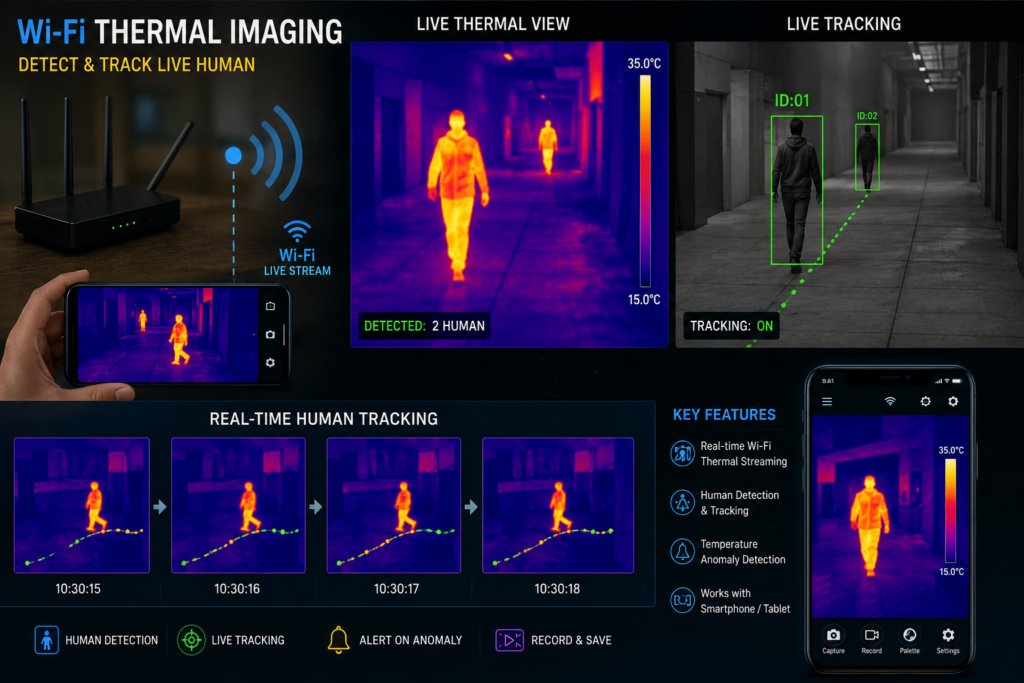
Most people view wireless networks as an invisible pipeline built strictly for internet connectivity. We connect our phones, stream high-definition videos, and join corporate meetings without giving a second thought to the physical radio waves bouncing around us. However, a major shift is occurring in wireless infrastructure. Modern routers are no longer just communication data hubs; they are transforming into highly perceptive environmental radars.
This breakthrough is known as Wi-Fi sensing technology. By analyzing the subtle disturbances in radio frequency (RF) signals as they move through a room, specialized algorithms can map human presence, track movement patterns, and even monitor vital signs without relying on traditional cameras or wearable devices. As security perimeters shift to accommodate smart environments, this capability introduces incredible opportunities alongside significant privacy challenges.
Understanding these invisible tracking mechanisms is becoming essential for anyone involved in modern digital defense. Whether you are pursuing structured cyber security training to understand wireless exploitation or working as an enterprise risk officer safeguarding corporate spaces, analyzing how RF data can be captured and manipulated is vital. Let’s explore how Wi-Fi sensing operates under the hood, its real-world use cases, and the security implications it introduces.
What is Wi-Fi Sensing Technology?
Wi-Fi sensing technology is an advanced measurement methodology that uses existing wireless radio signals to detect, track, and classify the movements of objects and people within a given space. Unlike a conventional security camera that captures visible light waves to form a pixelated image, a Wi-Fi sensing system acts as an indoor radar network.
The core premise relies on the physical properties of the human body. Our tissues are composed largely of water, which naturally absorbs, reflects, and scatters 2.4 GHz, 5 GHz, and newer 6 GHz radio frequencies. When a person walks between a Wi-Fi transmitter (like a router) and a receiver (like a smartphone or secondary access point), they disrupt the predictable path of the wireless signals. By continuously measuring these microscopic environmental changes, software systems can infer exactly what is happening inside an enclosed room.
Why It Is Important to Understand Wireless Tracking
The development of this technology represents a fundamental shift in how physical privacy and digital security intersect. Historically, if individuals wanted to keep their movements private, they could cover their webcams, avoid smart assistants, or leave their smartphones in another room. Wi-Fi sensing completely changes this dynamic.
Because ambient wireless signals penetrate drywall, wooden doors, and clothing, this tracking methodology functions completely through walls and in absolute darkness. It requires no active participation or awareness from the subject being monitored. As international standard bodies formalize these capabilities into consumer hardware, understanding how to audit, secure, and potentially intercept these signals is a critical frontier for the cybersecurity community.
How Wi-Fi Sensing Works: The Technical Breakdown
To understand how a standard router can track a person, we must look at the underlying telemetry data sent across modern wireless connections. The critical component that makes this possible is known as Channel State Information (CSI).
Understanding Channel State Information (CSI)
When a Wi-Fi device communicates with an access point, it doesn’t just send raw data packets. It also transmits preamble signals to assess the current condition of the wireless channel. The receiver analyzes these signals and generates a packet of diagnostic data called Channel State Information.
CSI acts as a highly detailed report card for the wireless link, capturing how the signal suffered from attenuation (loss of strength) and phase shifts along its journey. Every physical object in a room creates a distinct signature within the CSI data, acting as a unique environmental fingerprint.
The Role of MIMO and Multipath Propagation
Modern routers utilize Multiple-Input Multiple-Output (MIMO) technology, meaning they feature multiple antennas sending and receiving signals simultaneously. These signals bounce off the ceiling, reflect off the floor, and wrap around furniture before hitting the receiver—a phenomenon known as multipath propagation.
When a human enters this complex grid of overlapping signals, their movements alter specific propagation paths. Advanced mathematical algorithms process the stream of CSI fluctuations in real time, filtering out static reflections from couches or walls, leaving behind the pure kinetic signature of the moving human body.
Real-World Examples and Applications
While it sounds like science fiction, Wi-Fi sensing is rapidly moving out of academic research labs and entering commercial, industrial, and medical environments.
Smart Homes and Automation
Traditional motion sensors rely on passive infrared (PIR) technology, which requires a direct line of sight and fails if a person sits completely still. Wi-Fi sensing can detect the subtle chest movements of a person breathing. Smart home systems can use this data to keep lights or climate control active even if someone is quietly reading on a couch, eliminating the need for invasive cameras in private areas like bedrooms.
Elderly Care and Healthcare Monitoring
One of the most valuable implementations of this technology is non-invasive fall detection for senior citizens. If an elderly individual slips and falls, a Wi-Fi sensing system can instantly recognize the sudden, sharp shift in the CSI signal matrix and automatically alert healthcare providers. This protects the individual’s dignity by avoiding cameras in private spaces while ensuring constant monitoring.
Search and Rescue Operations
First responders and emergency services are exploring the use of portable wireless sensing nodes during structural collapses or fire scenarios. By deploying localized Wi-Fi grids across rubble, emergency personnel can analyze signal variations through thick concrete to pinpoint the exact locations and breathing rates of trapped survivors.
Cybersecurity and Privacy Risks: The Dark Side of RF Sensing
Every technological leap introduces new vectors for exploitation. From a defensive cybersecurity perspective, ambient wireless tracking introduces entirely new privacy vulnerabilities that traditional firewalls are unequipped to handle.
Passive Surveillance and Eavesdropping
Because wireless signals naturally bleed outside the physical perimeter of a home or corporate office, an adversary sitting in a vehicle parked on the street could deploy a high-gain antenna to passively capture your router’s ambient signals. By harvesting the broadcasted CSI data packets, the attacker could map out the internal floor plan of your office, track the movements of security guards, or determine exactly when a building is unoccupied without ever breaching the physical perimeter or installing malware.
Keystroke Leakage and Gesture Recognition
In highly controlled academic environments, researchers have demonstrated that ultra-high-resolution CSI analysis can track fine-grained motor movements. By analyzing the unique disruptions caused by a user’s hands moving over a desk, specialized machine-learning models have successfully reconstructed specific hand gestures and even individual keystrokes typed on a keyboard. This opens up theoretical possibilities for entirely passive, wireless side-channel attacks.
Exploiting the Technology in Practice
For professionals seeking to defend against these advanced threats, mastering the fundamentals of wireless packet analysis and signal processing is essential. Spending time on a specialized practical learning platform allows security researchers to interact with real-world wireless traffic, teaching them how to isolate anomalies within packet captures and identify when wireless infrastructure is leaking sensitive operational data.
Best Practices for Securing Wireless Environments
As the Institute of Electrical and Electronics Engineers (IEEE) integrates tracking capabilities into official specifications—most notably through the IEEE 802.11bf amendment—organizations must adjust their defensive strategies to protect their physical and digital perimeters.
- Implement Signal Shielding: For highly sensitive corporate environments, such as research laboratories or executive boardrooms, consider using RF-shielding building materials or window films. This contains wireless signals within the physical structure and prevents threat actors from capturing CSI data from public spaces.
- Regular Firmware Auditing: Ensure that corporate wireless routers and access points are regularly updated with secure firmware. Access to raw CSI data streams should be strictly restricted via internal access controls, preventing unauthorized internal software from harvesting environmental metrics.
- Deploy Dedicated Testing Frameworks: Organizations should proactively evaluate their wireless posture using professional VAPT services to ensure their networks do not expose unintended physical data to eavesdroppers outside their walls.
- Incorporate Signal Obfuscation: Future defensive frameworks may include signal-randomization techniques. By introduces subtle, artificial noise into the wireless transmission preamble, routers can scramble the physical signatures, making it impossible for unauthorized third parties to decode meaningful human movement from the stream.
The Future Scope of Wi-Fi Sensing
Looking ahead, Wi-Fi sensing is set to become an ambient component of our global digital infrastructure. With the rollout of the IEEE 802.11bf standard, wireless tracking capabilities will be natively baked into consumer and enterprise routing hardware by default.
We will likely see wireless networks seamlessly merge with other contextual sensing layers, including ultra-wideband (UWB) and radar arrays, to create highly responsive smart environments. For the security community, this means that identity verification, presence monitoring, and physical behavioral analytics will become deeply intertwined with traditional network management.
Career Opportunities in Wireless and Identity Security
The intersection of physical RF sensing and digital security is opening up new career paths within the technology sector. Organizations are searching for professionals who understand signal processing, wireless security protocols, and advanced telemetry analytics.
If you want to position yourself at the cutting edge of this evolution, investing time in comprehensive online cyber security courses can help you build the foundational knowledge necessary to pivot into hardware security, internet of things (IoT) defense, or wireless penetration testing.
Final Thoughts
Wi-Fi sensing technology demonstrates that the tools we rely on daily can possess hidden, dual-use capabilities far beyond their original design. While it offers game-changing benefits for healthcare and home automation, it fundamentally challenges our traditional assumptions about physical privacy and perimeter security.
As this technology becomes standardized, security teams must proactively audit their wireless infrastructure to prevent data leakage. If you are ready to evaluate your organization’s physical and digital security posture against advanced environmental vectors, contact a dedicated security consulting team to ensure your infrastructure remains resilient and secure.
Frequently Asked Questions (FAQs)
Can Wi-Fi sensing see through walls?
Yes. Because radio frequency signals in the 2.4 GHz and 5 GHz bands naturally pass through standard construction materials like drywall, plywood, and glass, a Wi-Fi sensing system can track human movement inside an enclosed room from an adjacent space or from outside the building.
Does Wi-Fi sensing require a camera to work?
No, it does not use optical components or lenses. It relies entirely on analyzing the variations, reflections, and phase shifts of radio waves traveling between wireless transmitters and receivers.
What is the IEEE 802.11bf standard?
IEEE 802.11bf is an upcoming official wireless standard amendment designed to turn Wi-Fi sensing into a native feature of future wireless hardware. It establishes a unified framework for measuring and sharing signal metrics like Channel State Information (CSI) for sensing purposes.
Can an attacker use my home router to spy on my movements?
While theoretically possible, an attacker would need to either compromise your router’s firmware to access the internal CSI stream or sit nearby with specialized equipment to capture the wireless packets passively as they travel through the air.
How does Wi-Fi sensing differentiate between a human and a pet?
Wi-Fi sensing software utilizes machine learning models trained on specific movement signatures. Humans generate distinct signal distortion patterns based on their height, mass, and walking gait, which differ significantly from the signatures created by pets or moving appliances like fans.
Can changing my Wi-Fi password prevent signal tracking?
No. Changing your password encrypts the data payloads of your internet traffic, but it does not stop the physical radio waves from bouncing off your body. The raw preamble signals and physical wave characteristics can still be analyzed by external receivers even if the data itself is securely encrypted.