
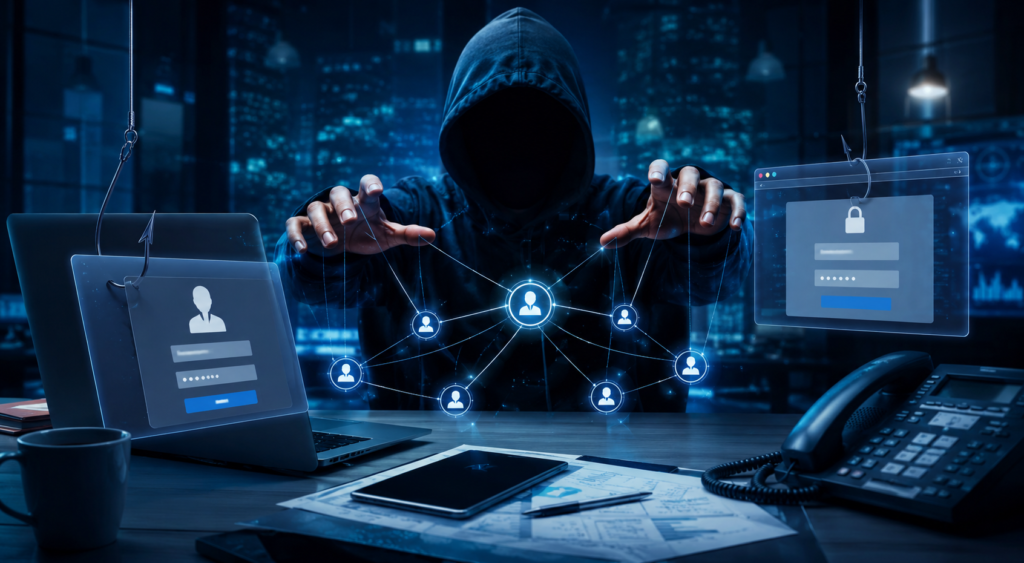
What Is Social Engineering in Cyber Security? Complete Guide
Introduction
Cyber attacks are no longer limited to malware, brute-force attacks, or software vulnerabilities. In many cases, attackers target people instead of systems. This is where social engineering becomes one of the most dangerous threats in cyber security.
Social engineering in cyber security refers to psychological manipulation techniques used by attackers to trick individuals into revealing sensitive information, granting unauthorized access, or performing actions that compromise security. Unlike technical hacking methods, social engineering exploits human trust, emotions, and behavior.
Over the last few years, social engineering attacks have increased significantly. Phishing campaigns, fake job offers, OTP scams, and business email compromise attacks continue to affect organizations of every size. According to the CISA, human error remains one of the leading causes of security breaches worldwide.
Understanding how social engineering works is essential for students, professionals, and businesses. Whether you are learning through cyber security training or managing enterprise infrastructure, recognizing manipulation tactics can help prevent major security incidents.
What Is Social Engineering?
Social engineering is a cyber attack technique where attackers manipulate human psychology to gain unauthorized access to systems, networks, or confidential information.
Instead of exploiting technical vulnerabilities directly, attackers exploit human behavior such as:
- Trust
- Fear
- Curiosity
- Urgency
- Greed
- Lack of awareness
For example, an attacker may impersonate a bank representative and convince a victim to share an OTP or password. In another scenario, a fake company recruiter may send a malicious attachment disguised as a job offer.
The primary goal is to make the victim voluntarily provide access or information.
Why Social Engineering Is Dangerous
Social engineering attacks are highly effective because humans are often the weakest link in security.
Even organizations with advanced firewalls and endpoint protection can become vulnerable if an employee clicks a malicious link or shares credentials unknowingly.
Key Reasons Why Social Engineering Works
Human Emotions Are Easy to Exploit
Attackers create situations that trigger emotional reactions. Fear-based scams often pressure victims into acting quickly without verification.
Attack Methods Look Legitimate
Modern phishing emails and fake websites can closely resemble legitimate services like Microsoft 365, Google, or banking portals.
Remote Work Increased Risks
Remote work environments have expanded the attack surface. Employees frequently communicate online, making impersonation attacks easier.
Lack of Security Awareness
Many users still fail to identify suspicious emails, fake login pages, or fraudulent messages.
Organizations investing in practical cyber security learning significantly reduce the success rate of such attacks.
Types of Social Engineering Attacks
Social engineering includes multiple attack techniques. Each method targets users differently.
Phishing Attacks
Phishing is the most common social engineering attack.
Attackers send fraudulent emails pretending to be trusted organizations. These emails usually contain:
- Fake login links
- Malicious attachments
- Password reset requests
- Urgent security alerts
Example
A victim receives an email claiming their Microsoft account will be suspended unless they verify credentials immediately. The email redirects to a fake login page controlled by attackers.
According to OWASP, phishing remains one of the top causes of credential theft.
Spear Phishing
Spear phishing is a targeted version of phishing.
Instead of sending mass emails, attackers research a specific individual or organization to create personalized attacks.
Example
An attacker studies a company’s LinkedIn employees and sends a fake HR document specifically to the finance department.
Because the email appears personalized, victims are more likely to trust it.
Vishing
Vishing stands for voice phishing.
Attackers use phone calls to impersonate banks, technical support teams, or government agencies.
Common Scenarios
- Fake KYC verification calls
- Fraudulent bank account alerts
- Tech support scams
- OTP theft calls
Vishing attacks are increasing rapidly in India and other countries due to widespread digital banking adoption.
Smishing
Smishing refers to phishing attacks conducted through SMS messages.
Attackers send fake messages containing malicious links or urgent requests.
Example
“Your bank account has been blocked. Verify immediately.”
Victims clicking the link are redirected to phishing websites.
Pretexting
Pretexting involves creating a fabricated scenario to obtain information.
The attacker builds trust by pretending to be someone legitimate.
Example
An attacker impersonates an IT support employee and asks users to share login credentials for “maintenance purposes.”
Baiting
Baiting attacks exploit curiosity or greed.
Attackers offer something attractive in exchange for user interaction.
Examples
- Free movie downloads
- Cracked software
- Fake giveaways
- Infected USB drives
These methods often install malware on victim devices.
Tailgating
Tailgating is a physical social engineering attack.
An unauthorized individual gains access to a secure building by following an authorized employee.
Example
An attacker carrying boxes requests someone to hold the office door open.
Without proper verification, physical security can fail.
How Social Engineering Attacks Work
Most social engineering attacks follow a structured process.
Research Phase
Attackers gather information from:
- Social media profiles
- Company websites
- Data breaches
- Public records
- LinkedIn accounts
This helps create believable attack scenarios.
Building Trust
Attackers impersonate trusted entities such as:
- Managers
- HR departments
- Banks
- Delivery companies
- Government agencies
The goal is to appear authentic.
Exploitation Phase
The victim is manipulated into:
- Sharing passwords
- Clicking malicious links
- Downloading malware
- Transferring money
- Disabling security controls
Execution
Once access is gained, attackers may:
- Steal data
- Deploy ransomware
- Perform financial fraud
- Move laterally across networks
Many penetration testers study these attack paths through hands-on labs and simulated phishing environments.
Real-World Social Engineering Examples
Understanding real incidents helps demonstrate the impact of social engineering.
Twitter Bitcoin Scam (2020)
In 2020, attackers compromised several high-profile Twitter accounts including Elon Musk and Barack Obama.
The attackers reportedly used social engineering techniques against Twitter employees to gain internal access.
This incident highlighted how employee manipulation can bypass technical defenses.
Uber Data Breach (2022)
An attacker used MFA fatigue attacks combined with social engineering to compromise Uber systems.
The attacker repeatedly sent MFA prompts until the employee approved one request.
This demonstrated how attackers exploit user behavior instead of technical vulnerabilities alone.
Business Email Compromise (BEC)
BEC attacks target organizations through fake executive emails.
Example
A finance employee receives an urgent request from the “CEO” asking for a confidential wire transfer.
Because the email appears legitimate, employees may process payments without verification.
According to the FBI, BEC scams have caused billions of dollars in losses globally.
Common Warning Signs of Social Engineering
Recognizing suspicious behavior is critical.
Red Flags Include
- Urgent requests for immediate action
- Requests for passwords or OTPs
- Unexpected attachments
- Poor grammar or unusual email formatting
- Suspicious URLs
- Emotional pressure tactics
- Unverified callers asking for sensitive data
Employees trained through online cyber security courses are generally more effective at identifying these warning signs.
How to Prevent Social Engineering Attacks
Preventing social engineering requires a combination of awareness, technology, and policies.
Security Awareness Training
Employee education is the most effective defense.
Organizations should regularly conduct:
- Phishing simulations
- Security awareness workshops
- Incident response training
Platforms offering learn cyber security programs help individuals understand practical attack scenarios.
Enable Multi-Factor Authentication (MFA)
MFA adds an extra layer of security.
Even if credentials are stolen, attackers may still require additional verification.
However, organizations should also protect against MFA fatigue attacks.
Verify Requests Independently
Always confirm sensitive requests through separate communication channels.
Example
If a manager requests a bank transfer via email, verify through a phone call before proceeding.
Avoid Oversharing on Social Media
Attackers frequently collect information from social media profiles.
Avoid publicly sharing:
- Work details
- Contact information
- Travel plans
- Employee structure
- Internal company activities
Use Email Security Solutions
Modern email security tools can detect:
- Phishing attempts
- Malicious attachments
- Suspicious domains
- Spoofed senders
Microsoft Defender and Google Workspace security tools provide strong phishing protection.
Perform Regular Security Assessments
Security assessments help identify vulnerabilities in employee awareness and infrastructure.
Organizations often use VAPT services to evaluate exposure to phishing and social engineering risks.
Tools Used in Social Engineering Assessments
Ethical hackers and penetration testers use controlled environments to test organizational awareness.
Common Tools
- GoPhish
- Social-Engineer Toolkit (SET)
- Evilginx
- King Phisher
These tools simulate phishing attacks for security testing and training purposes.
Professionals practicing in vulnerability labs often learn how attackers design phishing campaigns safely and ethically.
Social Engineering and Red Teaming
Red team engagements frequently include social engineering components.
Attackers may test:
- Employee awareness
- Physical security
- Email filtering
- Incident response readiness
Social engineering assessments help organizations understand real-world attack exposure.
Many companies partner with security consulting providers to strengthen defensive strategies.
Career Opportunities in Social Engineering Defense
As cyber threats continue to evolve, demand for security professionals is growing rapidly.
Popular Career Roles
- Security Analyst
- SOC Analyst
- Penetration Tester
- Red Team Operator
- Threat Intelligence Analyst
- Security Awareness Trainer
Professionals with practical experience in phishing simulations and human-focused attack analysis are highly valuable.
Learning through cyber security academy platforms can help beginners build strong foundational skills.
Future of Social Engineering Attacks
Social engineering attacks are becoming more sophisticated.
Emerging trends include:
- AI-generated phishing emails
- Deepfake voice scams
- QR code phishing
- MFA bypass techniques
- Social media impersonation attacks
As attackers improve psychological manipulation tactics, organizations must continuously update security awareness programs.
Cyber security is no longer only about protecting systems. It is equally about protecting people.
Conclusion
Social engineering remains one of the most effective cyber attack methods because it targets human behavior instead of technical vulnerabilities. Attackers exploit trust, urgency, and emotional reactions to bypass security controls and gain unauthorized access.
Understanding how phishing, vishing, smishing, and other manipulation techniques work is essential for individuals and organizations alike. Regular awareness training, multi-factor authentication, independent verification, and security assessments can significantly reduce the risk of compromise.
Whether you are starting your cyber security journey or improving enterprise defenses, practical learning and real-world simulations are critical. Platforms like PentestHint help learners and organizations strengthen their understanding of modern cyber threats through training, labs, and professional security services.
FAQs
What is social engineering in cyber security?
Social engineering is a cyber attack technique where attackers manipulate people into revealing confidential information or performing actions that compromise security.
What is the most common social engineering attack?
Phishing is the most common social engineering attack. It usually involves fake emails or websites designed to steal credentials or sensitive data.
How does phishing work?
Attackers send fraudulent emails or messages that appear legitimate. Victims are tricked into clicking malicious links or entering login credentials on fake websites.
Why are social engineering attacks successful?
These attacks succeed because they exploit human emotions such as fear, urgency, curiosity, and trust rather than technical vulnerabilities.
How can businesses prevent social engineering attacks?
Businesses can reduce risks through employee training, phishing simulations, multi-factor authentication, email filtering, and regular security assessments.
What is the difference between phishing and spear phishing?
Phishing targets large groups of users with generic messages, while spear phishing uses personalized information to target specific individuals or organizations.
Are social engineering attacks only online?
No. Social engineering can occur through phone calls, SMS messages, physical interactions, or social media communication.
Which industries are commonly targeted by social engineering?
Banking, healthcare, government, education, e-commerce, and technology sectors are frequently targeted due to the valuable data they store.
Suggested Category
Cyber Security Awareness