
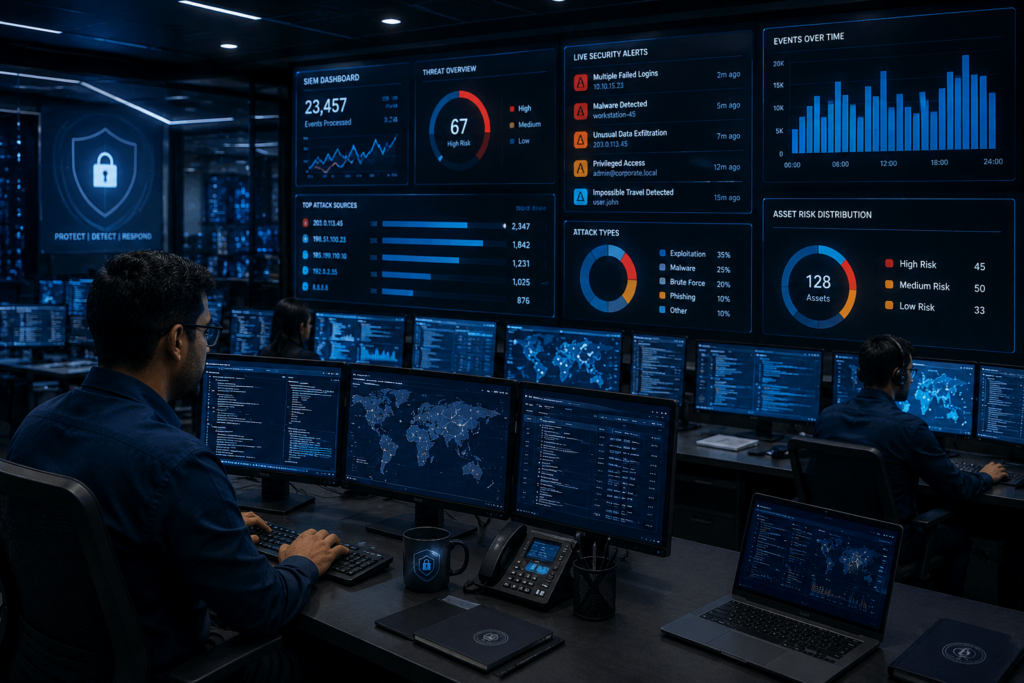
SIEM in cyber security stands for Security Information and Event Management. It is a security solution used to collect, analyze, correlate, and monitor logs from different systems inside an organization.
In simple words, SIEM helps security teams understand what is happening across servers, firewalls, endpoints, cloud platforms, applications, databases, and network devices. Without SIEM, security teams may have thousands or millions of logs, but no clear visibility into real threats.
Today, SIEM is a core part of modern Security Operations Centers. Whether you are a student trying to learn cyber security or a professional working in SOC, blue team, incident response, or compliance, SIEM is one of the most important technologies to understand.
What Is SIEM in Cyber Security?
SIEM is a platform that combines two major security functions:
- Security Information Management
- Security Event Management
Security Information Management focuses on collecting and storing logs for analysis, compliance, and reporting.
Security Event Management focuses on real-time monitoring, alerting, and threat detection.
Together, SIEM helps organizations detect suspicious activity, investigate incidents, and maintain audit evidence.
For example, if an attacker tries to brute-force a VPN account, the SIEM can collect failed login logs, identify multiple attempts from the same IP address, correlate them with firewall logs, and generate an alert for the SOC team.
Why SIEM Is Important in Cyber Security
Organizations use many systems every day. Each system generates logs.
Common log sources include:
- Firewalls
- Servers
- Active Directory
- VPN gateways
- Endpoint security tools
- Cloud platforms
- Web applications
- Databases
- Email gateways
- Proxy servers
- IDS/IPS systems
Manually checking logs from all these sources is not practical.
SIEM solves this problem by bringing logs into one central platform.
It helps security teams:
- Detect attacks faster
- Investigate incidents properly
- Monitor user activity
- Identify policy violations
- Support compliance audits
- Create security dashboards
- Track suspicious behavior
- Improve response time
For companies offering cyber security services, SIEM is often used to improve monitoring, detection, and reporting maturity.
How SIEM Works
SIEM works through a structured process.
1. Log Collection
The SIEM collects logs from multiple sources.
Examples include:
- Windows event logs
- Linux syslog
- Firewall traffic logs
- VPN authentication logs
- Web server logs
- Cloud audit logs
- Database logs
- Application logs
These logs are forwarded to the SIEM using agents, syslog, APIs, or connectors.
2. Log Normalization
Different devices generate logs in different formats.
For example, firewall logs look different from Windows event logs.
SIEM normalizes logs into a common format so analysts can search, compare, and correlate events easily.
3. Correlation
Correlation is one of the most powerful SIEM features.
It connects related events from different systems.
Example:
- VPN shows failed login attempts
- Firewall shows connection from a suspicious country
- Active Directory shows account lockout
- Endpoint shows malware detection
Individually, these logs may look normal. Together, they may indicate an active attack.
4. Alert Generation
When the SIEM detects suspicious activity based on rules, it creates an alert.
For example:
- Multiple failed logins in 5 minutes
- Admin login from unusual location
- Malware detected on endpoint
- Data transfer to unknown IP
- Privilege escalation attempt
- Disabled security service
The SOC team investigates these alerts.
5. Investigation and Reporting
SIEM allows analysts to search logs, build timelines, and understand attack activity.
Reports can be used for:
- Incident response
- Compliance audits
- Management review
- Security improvement planning
Real-World SIEM Example
Imagine an employee account gets compromised.
The attacker logs in using valid credentials. Since the password is correct, the login may not look suspicious at first.
However, the SIEM may detect:
- Login from a new country
- Access outside business hours
- Multiple failed attempts before success
- Access to sensitive file shares
- Large data download
- New mailbox forwarding rule
This combination of events can trigger a high-priority alert.
The SOC analyst can then investigate the account, disable access, preserve evidence, and escalate the incident.
This is why SIEM is important. It connects multiple signals and helps teams detect attacks that may otherwise go unnoticed.
Common SIEM Use Cases
SIEM is used for many security monitoring use cases.
Brute-Force Attack Detection
SIEM can detect multiple failed login attempts against VPN, email, web applications, or Active Directory.
Privileged Account Monitoring
Admin accounts are high-value targets. SIEM can alert when privileged users perform unusual activity.
Malware Detection
SIEM can collect alerts from antivirus, EDR, and endpoint tools to identify malware activity.
Suspicious Network Traffic
Firewall and proxy logs help SIEM detect communication with malicious IPs or unusual destinations.
Data Exfiltration
SIEM can detect large data transfers, unusual file downloads, or suspicious outbound traffic.
Insider Threat Detection
SIEM can monitor unusual user behavior, such as accessing sensitive files outside normal job responsibilities.
Cloud Security Monitoring
Cloud logs from AWS, Azure, or Google Cloud can help detect risky activities such as public storage exposure, new admin creation, or disabled logging.
Compliance Reporting
SIEM helps generate reports for standards like ISO 27001, PCI DSS, SOC 2, HIPAA, and other security frameworks.
SIEM in SOC Operations
A Security Operations Center uses SIEM as a central monitoring platform.
SOC analysts use SIEM to:
- Monitor alerts
- Investigate suspicious events
- Create incident tickets
- Perform threat hunting
- Review dashboards
- Generate reports
- Escalate confirmed incidents
Tier 1 SOC Analyst
A Tier 1 analyst usually performs initial alert triage.
They check:
- Is the alert valid?
- Is it a false positive?
- Which user or system is affected?
- Is escalation required?
Tier 2 SOC Analyst
A Tier 2 analyst performs deeper investigation.
They analyze:
- Attack timeline
- Indicators of compromise
- Lateral movement
- Malware behavior
- Impacted assets
Tier 3 Analyst or Threat Hunter
Advanced analysts use SIEM data to hunt for hidden threats.
They search for patterns that may not trigger normal alerts.
For students, working with cyber security labs helps build practical understanding of logs, attacks, and detection logic.
Popular SIEM Tools
Several SIEM tools are used in the industry.
Splunk
Splunk is widely used for log management, security analytics, and enterprise monitoring.
Microsoft Sentinel
Microsoft Sentinel is a cloud-native SIEM used with Microsoft security products and Azure environments.
IBM QRadar
QRadar is commonly used in enterprise SOC environments for threat detection and compliance.
Elastic Security
Elastic Security is popular for log analytics, detection engineering, and scalable search.
Wazuh
Wazuh is an open-source security monitoring platform often used for learning, compliance, and endpoint monitoring.
ArcSight
ArcSight is an enterprise SIEM platform used in large organizations.
Each SIEM tool has different strengths, but the core purpose remains the same: collect logs, detect threats, and support investigations.
SIEM Rules and Detection Logic
SIEM rules define what should trigger an alert.
Examples:
- More than 10 failed login attempts within 5 minutes
- Successful admin login from a new country
- PowerShell execution with suspicious parameters
- Multiple account lockouts from the same host
- New user added to Domain Admins group
- Firewall connection to known malicious IP
- Endpoint security disabled
Good detection rules reduce noise and improve accuracy.
Poor rules create too many false positives, which can overwhelm SOC analysts.
SIEM and MITRE ATT&CK
MITRE ATT&CK is often used to map attacker behavior.
SIEM detection rules can be aligned with MITRE techniques such as:
- Initial Access
- Execution
- Persistence
- Privilege Escalation
- Defense Evasion
- Credential Access
- Lateral Movement
- Exfiltration
External Reference:
MITRE ATT&CK
This helps security teams understand which attack techniques are covered by detection rules and where gaps exist.
SIEM vs EDR vs XDR
Many beginners confuse SIEM with EDR and XDR.
SIEM
SIEM collects and analyzes logs from many systems.
EDR
EDR focuses mainly on endpoint detection and response.
XDR
XDR combines detection and response across endpoints, email, cloud, network, and identity sources.
SIEM is broader in log collection and compliance reporting. EDR is deeper at endpoint level. XDR is more response-focused and integrated.
In many organizations, these tools work together.
SIEM Challenges and Limitations
SIEM is powerful, but it is not magic.
Common challenges include:
- Too many false positives
- Poor log source integration
- Missing critical logs
- Weak detection rules
- Lack of skilled analysts
- High storage cost
- Complex tuning requirements
- Poor incident response process
A SIEM only becomes useful when it is properly configured, monitored, and improved continuously.
Best Practices for SIEM Implementation
Identify Critical Log Sources
Start with the most important systems:
- Active Directory
- Firewall
- VPN
- Endpoint security
- Servers
- Cloud platforms
- Business-critical applications
Define Use Cases
Do not collect logs without purpose.
Create clear use cases such as:
- Brute-force detection
- Admin activity monitoring
- Malware alerting
- Data exfiltration detection
- Unauthorized access detection
Tune Alerts Regularly
SIEM alerts should be reviewed and improved.
Remove noisy rules and improve high-value detections.
Protect SIEM Logs
Logs should be protected from tampering.
Attackers often try to delete logs after compromise.
Create Incident Response Playbooks
Each important alert should have a response process.
For example:
- What should the analyst check?
- Who should be notified?
- When should the account be disabled?
- What evidence should be collected?
Test Detection Rules
Organizations should test whether SIEM rules actually detect attacks.
This can be done through red team exercises, purple team activities, and controlled attack simulations.
PentestHint helps organizations validate security controls through practical assessments and evidence-based reporting.
SIEM Skills Required for Cyber Security Careers
SIEM is a valuable skill for many roles.
Important skills include:
- Log analysis
- Networking basics
- Windows event logs
- Linux logs
- Active Directory security
- Threat detection
- Incident response
- MITRE ATT&CK mapping
- Basic scripting
- Query language knowledge
Different SIEM tools use different search languages. For example, Splunk uses SPL, while Microsoft Sentinel uses KQL.
Students can improve their skills through online cyber security courses and practical SIEM exercises.
Future of SIEM in Cyber Security
SIEM is evolving quickly.
Modern SIEM platforms are adding:
- User behavior analytics
- Cloud-native detection
- Machine learning support
- Automated response
- Threat intelligence enrichment
- SOAR integration
- Detection engineering workflows
In 2026, SIEM is not only a log management tool. It is becoming a central platform for detection, investigation, response, compliance, and security visibility.
Organizations that use SIEM properly can detect attacks faster and respond with better context.
Conclusion
SIEM in cyber security is one of the most important technologies used in modern security operations.
It collects logs, correlates events, detects suspicious activity, and helps SOC teams investigate incidents. From brute-force attacks to insider threats and cloud misconfigurations, SIEM gives organizations the visibility they need to protect critical systems.
For beginners, SIEM is a strong career skill. For businesses, SIEM is a key part of security monitoring and compliance.
If you want to build practical skills, start with log analysis, basic detection rules, Windows and Linux logs, and real-world scenarios through a practical learning platform. For structured learning, explore cyber security training and build hands-on experience step by step.
FAQs
What is SIEM in cyber security?
SIEM stands for Security Information and Event Management. It collects, analyzes, and correlates logs to detect security threats.
Why is SIEM important?
SIEM helps organizations detect attacks, investigate incidents, monitor user activity, and generate compliance reports.
Is SIEM used in SOC?
Yes. SIEM is one of the main tools used in Security Operations Centers for alert monitoring and incident investigation.
What are common SIEM tools?
Popular SIEM tools include Splunk, Microsoft Sentinel, IBM QRadar, Elastic Security, Wazuh, and ArcSight.
Is SIEM good for beginners?
Yes. SIEM is a good skill for beginners who want to work in SOC, blue team, incident response, or security monitoring.
What logs are collected by SIEM?
SIEM collects logs from firewalls, servers, endpoints, Active Directory, VPNs, cloud platforms, applications, and databases.
What is the difference between SIEM and EDR?
SIEM focuses on centralized log analysis, while EDR focuses on endpoint-level detection and response.