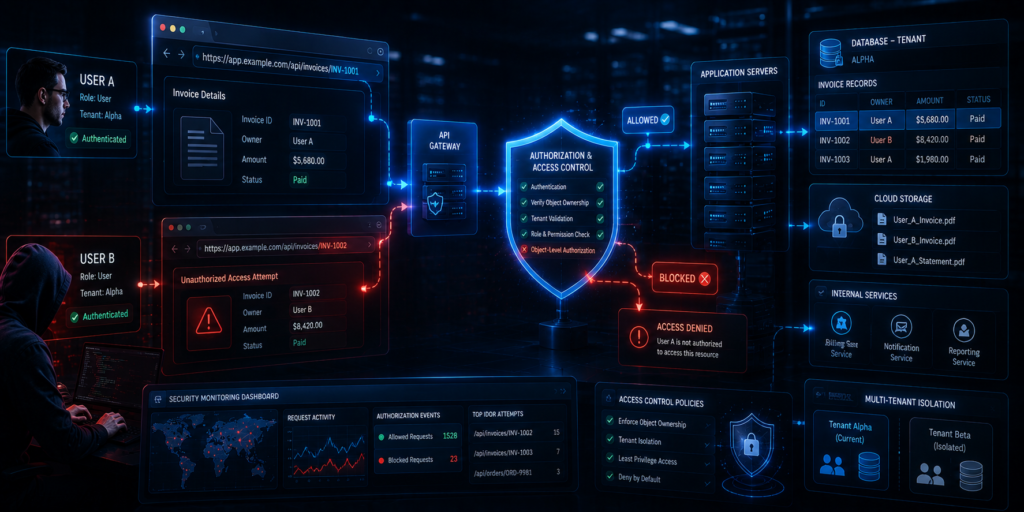

Remote Code Execution (RCE) is one of the most dangerous vulnerabilities in modern applications. It allows attackers to execute arbitrary commands on a vulnerable server or system, often leading to complete compromise. As organizations increasingly rely on cloud services, APIs, and web applications, identifying and mitigating RCE vulnerabilities has become a top security priority.
What is Remote Code Execution?
Remote Code Execution occurs when an application processes untrusted input without proper validation, allowing an attacker to run malicious code remotely. Unlike many other vulnerabilities, a successful RCE attack can provide direct control over the target system.
Common causes include insecure deserialization, command injection, unsafe file uploads, vulnerable third-party libraries, and software misconfigurations.
How Attackers Exploit RCE
A typical RCE attack starts by identifying an exposed vulnerability. After gaining code execution, attackers often establish persistence, escalate privileges, steal sensitive data, deploy ransomware, or move laterally across the network.
A well-known example is the Log4Shell (CVE-2021-44228) vulnerability, which allowed attackers to execute arbitrary code through crafted log messages. Similarly, the Apache Struts vulnerability (CVE-2017-5638) was exploited in the Equifax breach, exposing the personal information of millions of individuals.
Impact of RCE Vulnerabilities
The consequences of Remote Code Execution can be severe:
- Complete server compromise
- Data theft and financial loss
- Ransomware deployment
- Service disruption
- Regulatory compliance violations
- Reputational damage
Because attackers execute commands directly on the target system, RCE vulnerabilities are frequently rated as Critical under the CVSS scoring system.
Prevention and Remediation
Organizations should adopt a layered security approach to reduce RCE risk.
- Validate and sanitize all user input.
- Keep frameworks and third-party libraries updated.
- Disable unnecessary system command execution.
- Apply the principle of least privilege.
- Use Web Application Firewalls (WAFs) to detect exploitation attempts.
- Perform regular penetration testing and code reviews.
Security teams can also strengthen defenses through https://academy.pentesthint.com cyber security training and practice exploitation techniques safely using https://vuln.pentesthint.com hands-on labs.
For secure development guidance, refer to the OWASP Cheat Sheets https://owasp.org, NIST Secure Software Development Framework https://csrc.nist.gov, and CISA advisories https://www.cisa.gov.
Conclusion
Remote Code Execution remains one of the most critical security risks because a single vulnerable application can expose an entire organization. Understanding common attack chains, implementing secure coding practices, and conducting regular security assessments are essential for reducing risk.
Organizations seeking professional “https://pentesthint.com/“VAPT services or expert https://pentesthint.com security consulting can strengthen their security posture by identifying vulnerabilities before attackers do.