
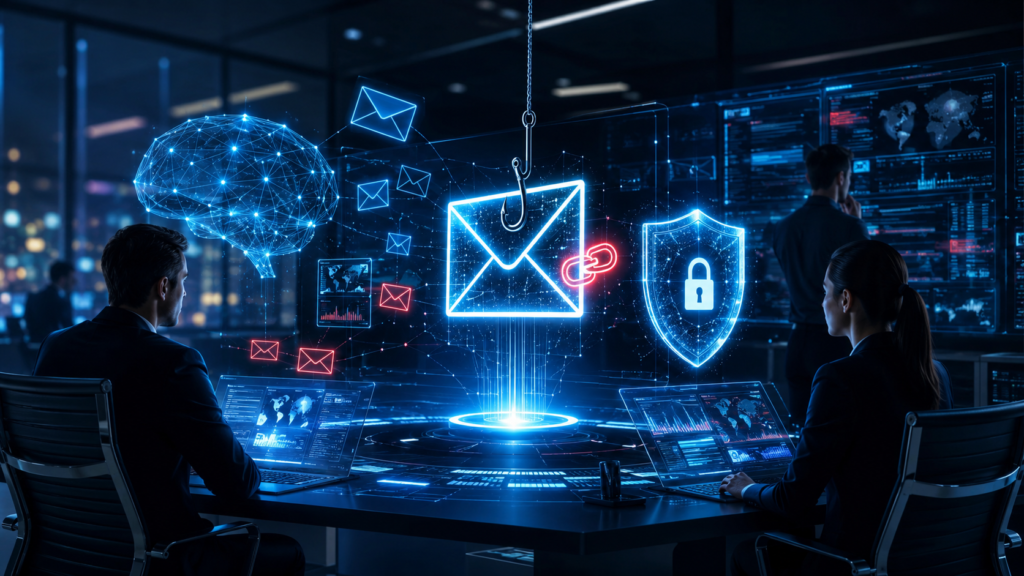
Phishing has remained one of the most successful cyberattack techniques for decades. However, the emergence of artificial intelligence has significantly changed how phishing campaigns are planned and executed. Today, AI-powered phishing attacks are more convincing, highly personalized, and much harder to detect than traditional phishing emails.
Attackers no longer rely on poorly written emails with obvious spelling mistakes. Instead, they use AI to generate professional-looking messages, imitate writing styles, analyze public information, and even create convincing voice and video impersonations. This evolution has made phishing one of the fastest-growing cybersecurity threats affecting organizations of every size.
Whether you are a security professional, business owner, student, or someone interested in cyber defense, understanding modern phishing techniques is essential. In this guide, you’ll learn how AI-powered phishing works, why it is becoming more dangerous, how attackers operate, and the best ways to defend against these advanced threats.
If you’re looking to strengthen your practical skills, consider <a href=”https://academy.pentesthint.com/“>learn cyber security</a> through structured courses that include real-world attack simulations.
Why AI is Changing the Phishing Landscape
Artificial intelligence has lowered the barrier to launching sophisticated phishing campaigns. Previously, attackers needed strong language skills, technical knowledge, and considerable time to craft convincing emails.
Today, AI automates many of these tasks.
Modern language models can:
- Write natural and grammatically correct emails
- Personalize messages for specific victims
- Mimic corporate communication styles
- Translate phishing emails into multiple languages
- Generate fake customer support conversations
- Produce convincing social engineering scripts
This enables attackers to target thousands of victims with highly customized messages while spending only a fraction of the effort required in the past.
What Are AI-Powered Phishing Attacks?
AI-powered phishing attacks are phishing campaigns that use artificial intelligence to improve social engineering, automate attack creation, personalize messages, and increase success rates.
Unlike traditional phishing, these attacks analyze publicly available information to make emails appear genuine.
Common AI-assisted techniques include:
- Personalized spear phishing
- Deepfake voice scams
- Fake video meetings
- AI-generated business emails
- Intelligent chatbot scams
- Automated phishing websites
Instead of sending generic emails, attackers now build messages that closely match the victim’s interests, job role, organization, and communication style.
How AI-Powered Phishing Attacks Work
Step 1: Information Collection
Attackers gather publicly available information from:
- Company websites
- Social media platforms
- Public GitHub repositories
- Data breaches
- News articles
This information helps AI create highly personalized messages.
Step 2: AI Content Generation
Instead of manually writing emails, attackers generate convincing messages using AI.
These emails often include:
- Correct grammar
- Professional formatting
- Company branding
- Personalized greetings
- Relevant business context
Many phishing emails now look nearly identical to legitimate corporate communications.
Step 3: Fake Infrastructure
Attackers register domains that closely resemble legitimate organizations.
Examples include:
- microsoft-login-support.com
- company-securityverify.com
Victims are redirected to fake login portals designed to steal credentials.
Step 4: Credential Theft
Once victims enter usernames, passwords, or MFA codes, attackers capture the information in real time.
Stolen credentials may later be used for:
- Business email compromise (BEC)
- Financial fraud
- Ransomware deployment
- Cloud account takeover
- Internal network access
Types of AI-Powered Phishing Attacks
Email Phishing
The most common type.
AI creates convincing business emails that imitate:
- HR departments
- Banks
- Microsoft 365
- Google Workspace
- Cloud providers
Spear Phishing
Targets a specific individual.
Example:
An HR manager receives an email referencing an actual hiring campaign currently posted on LinkedIn.
Because the information is accurate, the email appears legitimate.
Whaling
Executives receive personalized emails requesting:
- Wire transfers
- Contract approvals
- Confidential documents
AI helps attackers mimic executive writing styles with impressive accuracy.
Voice Phishing (Vishing)
AI-generated voices imitate executives, managers, or family members.
Example:
A finance employee receives a call that sounds exactly like the CEO requesting an urgent payment.
Deepfake Video Phishing
AI-generated videos imitate company executives during fake video meetings.
Several organizations worldwide have already reported financial losses caused by deepfake business meetings.
SMS Phishing (Smishing)
AI writes convincing text messages claiming to be from:
- Banks
- Delivery companies
- Government agencies
- Telecom providers
These messages often contain malicious links.
Why AI-Powered Phishing Is More Dangerous
Better Personalization
AI analyzes:
- Job roles
- Recent projects
- Public posts
- Company announcements
Every message feels personally written.
No Language Errors
Traditional phishing often contained obvious grammar mistakes.
Modern AI generates fluent, professional communication that is difficult to distinguish from legitimate emails.
Faster Campaigns
Attackers can generate thousands of customized phishing emails within minutes.
Automation dramatically increases attack scale.
Improved Success Rate
Personalized emails consistently outperform generic phishing campaigns because victims trust familiar language and relevant context.
Real-World Examples
Business Email Compromise
An attacker studies a company’s procurement process using LinkedIn.
AI generates emails impersonating the procurement manager requesting updated supplier bank details.
The finance team unknowingly transfers funds to the attacker’s account.
Fake Microsoft Login
Employees receive emails stating:
“Your Microsoft 365 password expires today.”
The email contains company branding, proper formatting, and realistic language.
Victims enter credentials into a cloned login page.
AI Voice Fraud
A financial executive receives a phone call that perfectly imitates the CEO’s voice.
The caller urgently requests an international payment before an acquisition announcement.
Without secondary verification, millions of dollars could be transferred to attackers.
Indicators of AI-Powered Phishing
Although these attacks are sophisticated, they still leave clues.
Watch for:
- Unexpected login requests
- Urgent payment demands
- MFA approval requests
- Unusual sender domains
- Slightly modified company URLs
- Unexpected document-sharing links
- Requests to bypass normal procedures
Always verify unusual requests using another communication channel.
Detection Techniques
Email Security Gateways
Modern email gateways analyze:
- Sender reputation
- Domain spoofing
- URL behavior
- Attachment sandboxing
- AI-generated content indicators
DMARC, SPF, and DKIM
These technologies help organizations verify legitimate email senders and reduce spoofing attacks.
AI-Based Threat Detection
Ironically, defenders are also using AI.
Modern security platforms analyze:
- Communication patterns
- User behavior
- Login anomalies
- Email reputation
- Writing inconsistencies
These systems identify suspicious emails before users interact with them.
User Awareness Training
Technology alone cannot stop phishing.
Employees should regularly learn:
- How phishing works
- How to verify requests
- How to report suspicious emails
- Social engineering techniques
Organizations looking for structured education can benefit from <a href=”https://academy.pentesthint.com/“>cyber security training</a> combined with practical exercises.
Prevention Best Practices
Enable Multi-Factor Authentication
Even if passwords are stolen, MFA provides an additional security layer.
Use phishing-resistant authentication whenever possible.
Verify Sensitive Requests
Always confirm:
- Financial transfers
- Password reset requests
- Vendor payment changes
Use phone calls or internal messaging platforms instead of replying directly to suspicious emails.
Apply Zero Trust Principles
Never assume any request is trustworthy simply because it originates from an internal email address.
Always verify identity.
Limit Public Information
Attackers rely heavily on publicly available information.
Organizations should carefully evaluate what employees publish on:
- Company websites
- Social media
Monitor Domain Registrations
Security teams should watch for domains resembling company brands.
Early detection reduces phishing success.
Conduct Phishing Simulations
Regular phishing simulations help employees recognize evolving attack techniques.
Hands-on experience is one of the most effective learning methods. Platforms offering <a href=”https://vuln.pentesthint.com/“>hands-on labs</a> and realistic attack environments can significantly improve defensive skills.
Security Tools That Help Detect AI-Powered Phishing
Several enterprise security solutions help identify advanced phishing campaigns.
Examples include:
- Microsoft Defender for Office 365
- Google Workspace Security
- Proofpoint
- Mimecast
- Cisco Secure Email
- CrowdStrike Falcon
- Microsoft Defender XDR
Organizations should combine these solutions with frameworks published by the “https://owasp.org/” OWASP, https://www.cisa.gov/” CISA, and “https://csrc.nist.gov/” NIST to strengthen their overall security posture.
Career Opportunities in Phishing Defense
As phishing attacks continue to evolve, organizations are investing heavily in cybersecurity talent.
Relevant career paths include:
- SOC Analyst
- Incident Responder
- Threat Hunter
- Email Security Engineer
- Security Consultant
- Digital Forensics Analyst
- Penetration Tester
- Security Awareness Specialist
Aspiring professionals can accelerate their journey through a “https://academy.pentesthint.com/” cyber security academy that combines theory with practical exercises.
Future of AI-Powered Phishing
AI-powered phishing is expected to become even more sophisticated over the coming years.
Future threats may include:
- Real-time multilingual voice cloning
- AI-generated fake meetings
- Hyper-personalized spear phishing
- Autonomous phishing campaigns
- AI-generated malicious websites
- Adaptive phishing bots
At the same time, defensive technologies will continue improving through behavioral analytics, AI-driven threat intelligence, and stronger authentication methods.
Organizations that continuously update security controls and employee awareness programs will be far better prepared for these evolving threats.
Conclusion
AI-powered phishing attacks represent a significant evolution in cybercrime. By combining artificial intelligence with traditional social engineering, attackers can create highly convincing emails, voice calls, and fake websites that are increasingly difficult to identify.
The best defense is a layered approach that combines employee awareness, strong authentication, email security technologies, threat monitoring, and continuous security testing. Businesses should also stay aligned with trusted cybersecurity frameworks and regularly assess their defenses against emerging threats.
If you want to sharpen your cybersecurity skills or test your knowledge in realistic environments, explore the learning resources available through “https://pentesthint.com/” PentestHint , including “https://vuln.pentesthint.com/” cyber security labs and professional “https://pentesthint.com/“VAPT services for organizations seeking stronger security.
FAQs
What are AI-powered phishing attacks?
AI-powered phishing attacks use artificial intelligence to generate convincing phishing emails, fake websites, voice scams, or personalized social engineering campaigns that increase the likelihood of victims revealing sensitive information.
Why are AI-powered phishing attacks more effective?
They use personalization, correct grammar, realistic formatting, and publicly available information to create messages that closely resemble legitimate business communication.
Can multi-factor authentication stop phishing?
MFA significantly reduces risk, but attackers may still attempt to steal session tokens or MFA codes. Phishing-resistant MFA methods offer stronger protection.
How can businesses defend against AI-powered phishing?
Organizations should deploy secure email gateways, enforce MFA, implement DMARC/SPF/DKIM, conduct regular phishing awareness training, and continuously monitor for suspicious activity.
What is the difference between phishing and spear phishing?
Traditional phishing targets many users with generic messages, while spear phishing focuses on specific individuals using personalized information.
Are deepfake voice attacks considered phishing?
Yes. AI-generated voice impersonation is a form of social engineering that aims to deceive victims into sharing information or authorizing financial transactions.
Which industries are most targeted?
Financial services, healthcare, government agencies, technology companies, education, and manufacturing are among the most frequently targeted sectors.

One thing that stood out is how AI makes phishing more convincing through better personalization and fewer language mistakes, which means people can no longer rely on obvious red flags. I’d also add that organizations should regularly rehearse out-of-band verification for urgent payment or account requests, since even well-trained employees can be pressured by realistic AI-generated emails or voice calls. Defense really has to combine technical controls with consistent human habits.