
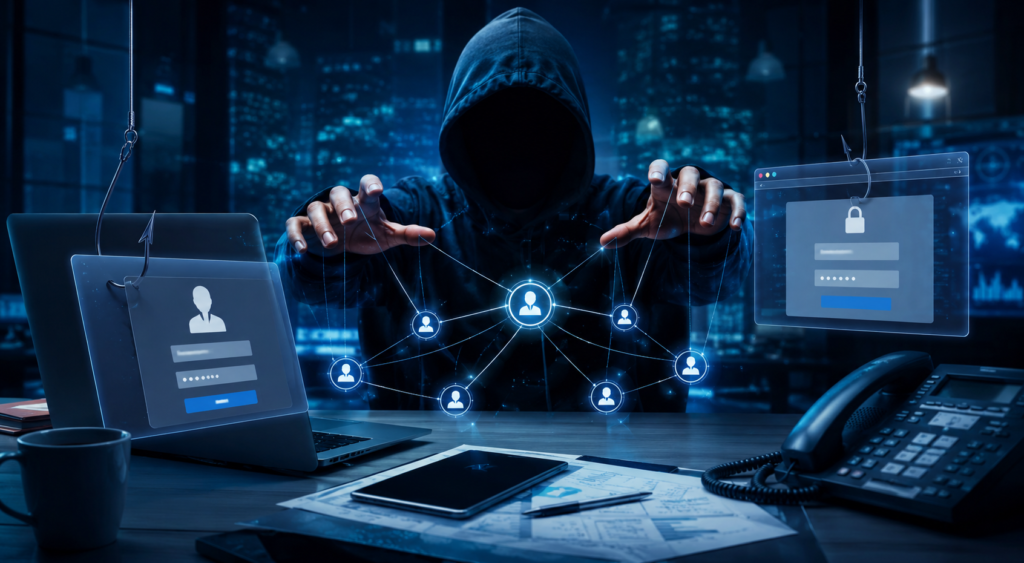
Cybercriminals no longer rely only on malware or advanced hacking tools. In many modern breaches, the weakest point is human behavior. Social engineering in cyber security focuses on manipulating people into revealing sensitive information, downloading malicious files, or granting unauthorized access.
From phishing emails to fake tech support calls, social engineering attacks continue to grow in sophistication. Attackers study psychology, emotions, urgency, and trust to exploit employees, customers, and even experienced IT professionals.
According to reports from trusted organizations like the and , phishing and social engineering remain among the leading causes of ransomware infections and credential theft. Businesses of all sizes are vulnerable because these attacks target people instead of software vulnerabilities.
In this guide, we will explore how social engineering works, common attack methods, real-world incidents, prevention strategies, and best practices that organizations should follow.
What is Social Engineering in Cyber Security?
Social engineering is a cyber attack technique where attackers manipulate individuals into performing actions that compromise security. Instead of attacking systems directly, criminals exploit human emotions such as fear, curiosity, urgency, or trust.
The primary goal of social engineering attacks is usually to:
- Steal login credentials
- Gain unauthorized access
- Install malware
- Transfer money fraudulently
- Collect confidential data
- Bypass security procedures
Unlike traditional hacking methods, social engineering attacks often appear legitimate. Attackers may impersonate trusted organizations, coworkers, banks, or government agencies.
A simple phishing email can sometimes achieve what advanced malware cannot.
Why Social Engineering Attacks Are So Effective
Human psychology is difficult to patch. Even organizations with strong firewalls and endpoint protection can become victims when employees make small mistakes.
Several factors make social engineering highly successful:
Emotional Manipulation
Attackers create fear, urgency, or excitement to pressure victims into acting quickly.
Examples include:
- “Your account will be suspended”
- “Immediate payment required”
- “You received a confidential salary document”
Trust Exploitation
Cybercriminals impersonate managers, IT departments, vendors, or financial institutions to gain credibility.
Lack of Security Awareness
Employees without proper security training may fail to identify suspicious links or fake websites.
Organizations investing in cyber security training often reduce the success rate of phishing and impersonation attacks significantly.
Common Types of Social Engineering Attacks
Phishing Attacks
Phishing is the most common form of social engineering. Attackers send fraudulent emails or messages designed to steal credentials or distribute malware.
Typical phishing tactics include:
- Fake password reset emails
- Banking verification requests
- Delivery tracking scams
- Fake invoice attachments
Attackers often clone legitimate websites to trick users into entering usernames and passwords.
Trusted guidance from explains how phishing campaigns frequently bypass weak security awareness practices.
Spear Phishing
Spear phishing is a targeted version of phishing. Instead of sending mass emails, attackers research specific individuals or organizations.
These attacks are more convincing because they include:
- Employee names
- Company information
- Internal references
- Personalized messages
Executives and finance departments are common targets.
Business Email Compromise (BEC)
Business Email Compromise attacks involve impersonating executives or vendors to trick employees into transferring funds or sensitive information.
BEC attacks have caused billions of dollars in losses worldwide.
Attackers may:
- Spoof email addresses
- Hijack legitimate accounts
- Request urgent wire transfers
- Send fake invoice approvals
Vishing (Voice Phishing)
Vishing uses phone calls instead of emails.
Attackers may pretend to be:
- Bank representatives
- Technical support agents
- Government officials
- Delivery companies
The goal is to convince victims to reveal sensitive information such as OTPs, passwords, or banking details.
Smishing (SMS Phishing)
Smishing attacks use text messages containing malicious links or fraudulent requests.
Examples include:
- Fake courier delivery updates
- Banking alerts
- Prize scams
- KYC verification requests
These attacks are increasingly common due to smartphone usage growth.
Pretexting
In pretexting attacks, criminals create a fabricated scenario to gain trust.
For example:
- An attacker pretending to be HR requesting employee records
- Someone impersonating IT support asking for login credentials
- Fake auditors requesting confidential documents
Pretexting often involves extensive research about the victim.
Baiting Attacks
Baiting relies on curiosity or temptation.
Examples include:
- Infected USB drives labeled “Salary Data”
- Fake software downloads
- Free movie or game downloads containing malware
Once opened, malicious software infects the victim’s device.
Tailgating and Physical Social Engineering
Not all social engineering happens online.
Tailgating occurs when unauthorized individuals gain physical access by following employees into restricted areas.
Attackers may:
- Dress as delivery personnel
- Carry fake ID cards
- Pretend to be maintenance workers
Physical security failures can lead to severe breaches.
How Social Engineering Attacks Work
Most social engineering attacks follow a structured process.
Research Phase
Attackers collect information from:
- Social media
- Company websites
- Public databases
- Employee profiles
LinkedIn is commonly used to identify employees and organizational structures.
Building Trust
The attacker impersonates a trusted person or organization.
They may use:
- Company logos
- Fake domains
- Professional communication styles
Exploitation
The victim is encouraged to:
- Click malicious links
- Share credentials
- Open infected files
- Approve payments
Execution
Once access is obtained, attackers may:
- Install ransomware
- Steal data
- Move laterally across networks
- Conduct financial fraud
Hands-on practice using cyber security labs helps professionals understand how these attacks operate in real environments.
Real-World Social Engineering Attack Examples
The Twitter Bitcoin Scam (2020)
One of the most famous social engineering attacks targeted employees.
Attackers used phone-based social engineering to trick employees into providing internal access credentials. High-profile accounts belonging to celebrities and companies were compromised.
The attackers posted fraudulent cryptocurrency giveaway messages from verified accounts.
This incident demonstrated that even major technology companies can be vulnerable to human-focused attacks.
Target Data Breach (2013)
The breach began with stolen credentials from a third-party HVAC vendor.
Attackers used social engineering and credential theft to gain network access. Eventually, they compromised payment systems affecting millions of customers.
The incident highlighted the risks associated with vendor access and weak third-party security controls.
Google and Facebook Invoice Fraud
Attackers impersonated a legitimate hardware supplier and tricked employees at and into making fraudulent payments.
The scam reportedly resulted in losses exceeding $100 million before detection.
This case showed how sophisticated business email compromise schemes can bypass traditional technical defenses.
RSA Security Breach
The breach reportedly started with a phishing email containing a malicious attachment disguised as an Excel spreadsheet.
Once opened, malware infected internal systems and compromised sensitive information related to security tokens.
The attack became a major example of targeted spear phishing.
Signs of a Social Engineering Attack
Employees should watch for common warning signs.
Suspicious Urgency
Attackers often demand immediate action to prevent rational thinking.
Examples:
- “Act within 10 minutes”
- “Your account will be disabled today”
Unusual Requests
Be cautious when someone requests:
- Passwords
- OTPs
- Financial transfers
- Sensitive documents
Legitimate organizations rarely request such information via email or phone.
Poor Grammar or Strange Formatting
Some phishing emails contain spelling mistakes or unusual formatting, although advanced attacks can appear highly professional.
Mismatched URLs
Always verify website addresses carefully before entering credentials.
Fake domains often imitate legitimate brands.
How to Prevent Social Engineering Attacks
Employee Security Awareness Training
Security awareness remains one of the strongest defenses against social engineering.
Organizations should regularly conduct:
- Phishing simulations
- Awareness workshops
- Incident response exercises
Platforms offering online cyber security courses can help teams improve practical security skills.
Multi-Factor Authentication (MFA)
Even if passwords are stolen, MFA adds an additional security layer.
Organizations should enable MFA for:
- Email accounts
- VPN access
- Cloud platforms
- Administrative systems
Email Security Solutions
Advanced email security tools help detect:
- Malicious attachments
- Fake domains
- Suspicious links
- Spoofed senders
Solutions from trusted providers like and include phishing protection features.
Verify Financial Requests
Always confirm wire transfer requests or sensitive financial actions through secondary communication channels.
A quick phone call can prevent major fraud.
Principle of Least Privilege
Employees should only have access to systems necessary for their roles.
Limiting privileges reduces the impact of compromised accounts.
Incident Reporting Culture
Employees should feel comfortable reporting suspicious emails or calls immediately.
Fast reporting helps security teams respond before attacks spread.
Best Practices for Organizations
Conduct Regular Security Assessments
Routine assessments help identify weaknesses in security processes and employee awareness.
Organizations seeking professional VAPT services can identify risks before attackers exploit them.
Simulate Real-World Attacks
Red team exercises and phishing simulations improve readiness.
Using hands-on labs helps security teams practice detection and response techniques.
Implement Zero Trust Security
Zero Trust assumes no user or device should be trusted automatically.
Key principles include:
- Continuous verification
- Identity-based access control
- Network segmentation
Monitor Employee Accounts
Unusual login behavior, location changes, or abnormal activity may indicate compromised accounts.
Security monitoring tools can detect suspicious patterns early.
Future of Social Engineering Attacks
Social engineering attacks continue evolving with new technologies.
Emerging trends include:
- AI-generated phishing emails
- Deepfake voice scams
- Social media impersonation
- QR code phishing attacks
Attackers are becoming more sophisticated and personalized in their targeting methods.
Organizations must combine:
- Technical controls
- Continuous education
- Security monitoring
- Strong incident response plans
Continuous practical cyber security learning is becoming essential for both beginners and experienced professionals.
Conclusion
Social engineering in cyber security remains one of the most dangerous and effective attack methods because it targets human behavior rather than software vulnerabilities.
From phishing emails to executive impersonation scams, attackers continuously develop new ways to manipulate employees and bypass traditional defenses. Businesses that focus only on technical security tools without improving employee awareness remain highly vulnerable.
Strong security awareness training, multi-factor authentication, phishing simulations, and continuous monitoring are critical for reducing risk. Organizations should also regularly test their defenses using real-world vulnerable machines and professional security assessments.
At PentestHint, organizations and learners can explore practical training, security testing resources, and modern cyber security learning approaches designed for real-world threats.
FAQ Section
What is social engineering in cyber security?
Social engineering is a cyber attack method where attackers manipulate people into revealing confidential information or performing actions that compromise security.
What is the most common social engineering attack?
Phishing is the most common type of social engineering attack. It usually involves fake emails or websites designed to steal credentials or distribute malware.
How do hackers use social engineering?
Hackers exploit trust, fear, urgency, and human psychology to convince victims to click malicious links, share passwords, or approve fraudulent transactions.
Can social engineering attacks affect small businesses?
Yes. Small businesses are frequent targets because they often have weaker security awareness programs and fewer protective controls.
How can companies prevent social engineering attacks?
Companies can reduce risk through:
- Employee awareness training
- Multi-factor authentication
- Email filtering
- Security monitoring
- Regular phishing simulations
What is the difference between phishing and spear phishing?
Phishing targets large groups using generic messages, while spear phishing targets specific individuals with personalized and highly convincing content.
Are social engineering attacks only online?
No. Social engineering can occur through phone calls, text messages, social media, or even physical interactions like tailgating.
Why is employee training important in cyber security?
Employees are often the first line of defense. Proper training helps them identify suspicious behavior and avoid falling victim to cyber attacks.