
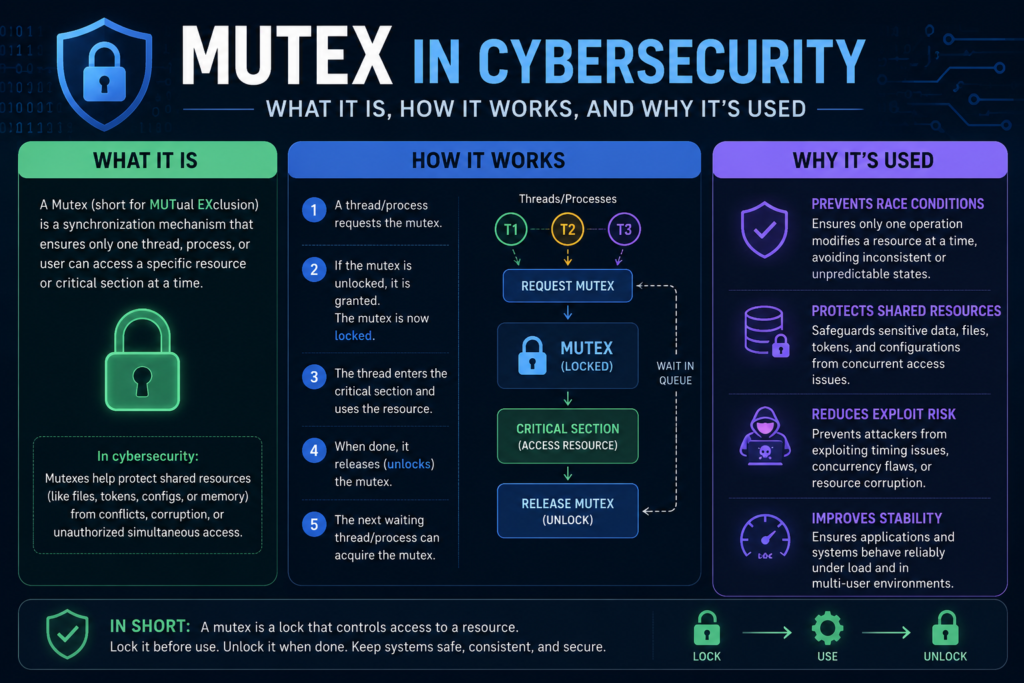
The word «mutex» sounds like someone has decided to make life difficult for an ordinary person again. In fact, the term is quite mundane. Mutex, or mutex, comes from the phrase mutual exclusion, that is, «mutual exclusion». We are talking about a mechanism that prevents two threads, processes or instances of a program from working with the same resource at the same time.
In programming without such a mechanism, chaos quickly begins. No one needs chaos in cybersecurity either, especially when malware, the protective agent or sample to be analyzed attempts to control the behavior of the system.
For information security specialists, mutex is interesting from several angles. Developers of legitimate software use it for synchronization. Malware authors use mutexes to avoid running malicious code twice, flagging an infected system, or coordinating components.
Analysts look for mutex names as indicators of compromise. The picture is interesting: the same mechanism can be part of a normal program architecture and at the same time important evidence in incident investigations.
Understanding mutex helps to better understand the behavior of software on end devices, read reports on malicious software, and avoid confusing technical synchronization with some kind of «cunning hacker magic». There is no magic here. There is a neat way to agree on who gets access to a resource and when. And then everything depends on the intentions of the one who uses the mechanism.
What mutex is in simple words
If explained without an academic touch, a mutex is like the key to one room. Until one employee has the key, the second one will not go inside. When the first one has finished and returned the key, the second one can come in. In code, the role of a room is played by a shared resource: a file, a piece of memory, a database, a configuration, or some object in the operating system.
When a process or thread tries to capture a mutex, the system checks the state of the mechanism. If the mutex is free, the thread gains access and continues to work. If the mutex is already busy, another thread waits for release. Due to this scheme, the program avoids conflicts, data corruption and races, in which the result depends not on logic, but on who managed first.
In cybersecurity, mutexes are especially often remembered in context Windows. There, a mutex object can exist at the system level and have a name. Having a name makes the mechanism convenient not only for developers, but also for attackers. One instance of the malware creates a named mutex, and the next one checks if such an object exists at startup. If it exists, the new instance realizes that the system is already infected or the code is already running and terminates execution.
From a practical point of view, mutex can be considered a state marker. The program seems to leave a sign «busy». For a legitimate application, the nameplate means protection against restarting. For a trojan, a sign can mean «colleagues are already inside, no extra noise is needed».
How mutex works and why problems arise without it
Mutex works around a simple sequence. First, the program tries to create or open a mutex object. The program then captures the object and enters the critical section, that is, the section of code where exclusive access is needed. After the operation is completed, the program releases the mutex. If no release has occurred, the remaining members may hang in anticipation. Yes, even a neat mechanism has very sloppy consequences.
The main purpose of mutex is to prevent the simultaneous execution of dangerous operations. Let’s imagine two threads writing to the same log file or changing the same registry key. Without synchronization, one thread can erase the data of another, mix records, or cause the structure to fall into an inconsistent state. The result ranges from minor failures to process failure.
The mechanism is also useful for security solutions. Antivirus agent, EDR Sensor or the utility module can use mutex to avoid running two identical service instances and creating a conflict when accessing data. When it comes to a software agent that is already deep in the system, an extra take is definitely not needed.
Problems begin when the developer incorrectly selects the moment of capture and release or allows mutual blocking. Mutual blocking occurs when one thread holds mutex A and waits for mutex B, and the other holds mutex B and waits for mutex A. As a result, both stand still. It’s unpleasant for a regular program, but it’s no longer good for security software on a workstation.
Why mutexes are used in cybersecurity and malware
Malware likes mutexes not for romantic reasons, but for pragmatic ones. The first scenario is the most common: no reinfection. If one instance is already active, a second one is not needed. Restarting increases noise, consumes resources, and increases the chance that the user or security system will notice the anomaly.
The second scenario involves identifying the infected machine. Malware can create a mutex with a unique name and then use the object’s existence as a sign that the implementation stage has already been completed. Sometimes the mutex name is stitched into the code statically, sometimes it is generated based on the computer name, domain, disk serial number, or other parameters. This approach complicates analysis and helps distinguish «our» hosts from others.
The third scenario concerns module coordination. One component loads the payload, the second is responsible for persistence, and the third waits for a command from the command server. Mutex helps prevent modules from interfering with each other or running in parallel in the wrong sequence. Basically, even a malicious set of tools sometimes prefers a coordinated sequence to a chaotic start.
For analysts, the mutex name can be a useful artifact. By rows in the sample, by events in the sandbox, and by EDR telemetry you can see which object created or opened the suspicious process. Sometimes the same mutex is found in the malware family, and sometimes it serves as a good IOC for finding infected hosts in the infrastructure.
- prevent the malicious process from restarting;
- mark an already infected system;
- synchronize the actions of multiple malware components;
- hide the logic behind the normal system mechanism;
- leave an artifact, which the researcher will then notice.
How mutexes help protectors and researchers
Cybersecurity experts look at mutex not as a mysterious object, but as an observable sign of behavior. During reverse engineering the analyst studies strings, API calls, and the execution chain. If the sample accesses the mutex creation or opening functions, the episode immediately comes into view. The name of the object sometimes directly indicates the malware family, and sometimes suggests the author’s logic.
In sandboxes and monitoring systems, mutex events can also be useful. One separate mutex rarely produces a reinforced concrete output, but when combined with network activity, file creation, injection into the process, and registry changes, the picture becomes much clearer. A good analyst doesn’t fall in love with one artifact. A good analyst puts together a puzzle of several features.
In practice, mutexes can be used in detection rules, in threat intelligence reports, and in threat hunting. If the researcher knows the characteristic mutex name for a particular campaign, the SOC team can check the telemetry for the endpoints and find matches. The reverse action is also useful: collect a list of unusual named mutexes in the system and compare the results with known malware families.
However, any mutex can’t be declared a sign of an attack. Legitimate applications create thousands of similar objects. Therefore, mutex has value not in itself, but in context. Otherwise, the investigation will quickly turn into a shadow hunt, and, as you know, the easiest way to avoid the real tasks of the investigation is to look for shadows.
| The script | How mutex is used | What the analyst gets |
|---|---|---|
| Legitimate software | Blocks restart and synchronizes resource access | Normal system object without malicious meaning |
| Malware | Checks for another instance and marks the infection | Artifact for IOC and Behavioral Analysis |
| Sandbox and EDR | The creation, opening and use of mutex are recorded | Telemetry to correlate with other events |
How mutex differs from other mechanisms and what to remember
Mutex is often confused with a semaphore, a file lock, or simply a flag in memory. Difference in purpose and access model. Mutex usually gives entry rights to only one owner. Semaphore can allow access to multiple participants at once. The in-memory flag does not provide reliable interprocess synchronization at all without additional measures. Therefore, the name of the mechanism is important, especially when the analyst analyzes the behavior of the sample based on system calls.
For cybersecurity, mutex is important for two reasons. The first reason is technical: mutex helps programs work predictably and not break their own logic. The second reason is analytical: the named mutex leaves a trace that can be examined, compared with known samples, and used in detection. This dual role makes the mechanism especially interesting for reverseers, threat hunters, and security rule writers.
The bottom line is that mutex cannot be considered either a purely «good» or a purely «evil» instrument. Here we see a regular system mechanism that is equally accessible to both the developer of the corporate agent and the author of the Trojan. The difference appears in why the object is created, what the object is called and what actions follow. In cybersecurity, that’s how almost everything works. Suspicion arises not from one detail, but from a bunch of details.
Therefore, it’s not just programmers who need to know mutex. For an editor, threat researcher, SOC analyst, and forensics specialist, the term has long gone beyond multithreading textbooks. When a mutex string appears in a malicious activity report, it’s not an abstract technical detail in front of the reader, but a very specific trace of someone else’s presence in the system.